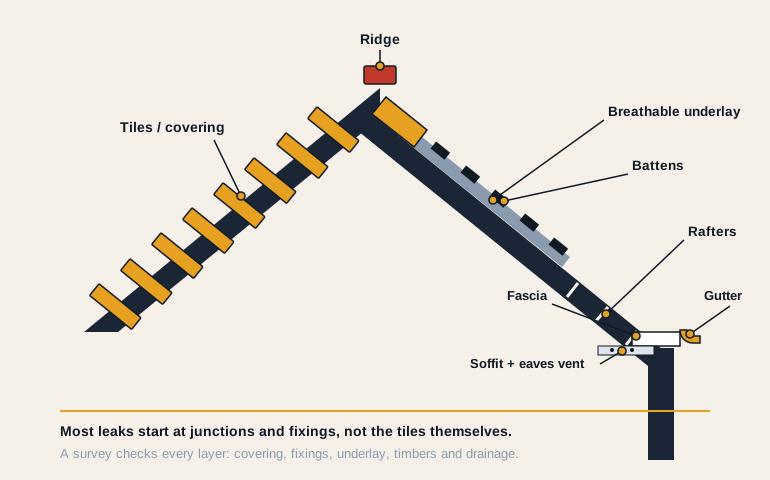
Fast, honest roof repairs across Derby city and all Derbyshire postcodes. Missing tiles, failed ridge mortar, lead flashing leaks and everything in between — fixed right first time.
Roof repairs in Derby typically cost £150–£900 depending on scope — from a single slipped tile to a full ridge repoint. Derby Roofing Experts provide free written quotes, a 10-year workmanship guarantee, and 24/7 emergency cover across the city. Call 0133 240 5131 for a fixed-price quote.
Derby's housing stock creates a specific and predictable set of repair demands. The 1960s–70s concrete tile estates that cover large areas of the city — Normanton, Chaddesden, Derby Hill, Mackworth — are all now at the age where mortar failure becomes widespread. Ridge tiles lifting, verge pointing crumbling and open hip joints are the tell-tale signs. Left unattended, these lead directly to water ingress in the loft, damaged ceiling joists, and eventually structural problems.
On the Victorian and Edwardian stock around Friar Gate, the Cathedral Quarter and Darley Abbey, the issues are different. Lead flashings around chimney stacks are the primary failure point — Derby's frost cycles work water into any small gap over winter, and each year the flashing lifts a little more. Matching original Welsh slate on these properties requires sourcing, and we stock a range to avoid visible patchwork repairs on period roofs.
Repair Pricing Guide
Slipped / Missing Tiles
£150–£300
Replace and re-secure, inspect surrounding tiles
Ridge Repointing
£400–£900
Re-bed and repoint ridge, verge or hip mortar
Lead Flashing Repair
£200–£500
Re-dress or replace flashing around chimney or abutment
Valley Repair
£300–£700
Re-lead or re-tile valley, clear debris and check falls
No Call-Out Fee
We don't charge to come and look. All roof repair quotes are free and provided in writing before any work starts. The price we quote is the price you pay.
Customer Reviews
What Do Derby Homeowners Say?
★★★★★
“Had several ridge tiles loose on our 1970s semi in Chaddesden. They came the next morning, re-bedded the full ridge and repointed the verges. Clear quote upfront, no extras on the invoice.”
Steve P. · Chaddesden, Derby
★★★★★
“Persistent leak above the bathroom. Two other roofers couldn't find it. Derby Roofing traced it to a hairline crack in the lead valley and fixed it the same day. Very thorough.”
Amanda J. · Darley Abbey, Derby
★★★★★
“Needed like-for-like Welsh slate to match our Victorian terrace near Friar Gate. They sourced matching reclaimed slate and you can't tell where the repair is. Excellent workmanship.”
Chris N. · Friar Gate, Derby
The Repair vs Replace Decision
This is the question we're most often asked, and the honest answer depends on three factors: the age of the roof, the condition of the underlying structure, and the scope of the current failure. A 1960s concrete tile roof in Normanton where individual tiles are slipping but the structure is sound is a repair. The same roof where the felt has failed across large areas, the battens are splitting and five separate sections of ridge mortar have gone simultaneously is a replacement. We make this call honestly — we have no financial incentive to recommend replacement when repair is the better choice, and we carry the materials for most repairs on every van.
The most useful test: if a repair will last 10+ years without further major intervention, it's the right answer economically. If the same repair will need repeating within 5 years because the surrounding roof is at the same stage of deterioration, full replacement gives better value over a 10-year window.
Why Derby Repairs Are Different From Elsewhere
Derby's 1960s–70s concrete tile estate stock creates a repair profile that's different from most UK cities. The uniformity of the build era means that when mortar fails on a Normanton or Chaddesden semi, it often fails across the full ridge and verge simultaneously — not just a single section. A partial repoint that addresses only the visibly failed sections while leaving adjacent deteriorated mortar in place will result in a second call-out within 2–3 years as the adjacent sections catch up. We repoint the full ridge run on first visit as standard, because the economics of a second scaffold hire and call-out don't make sense for anyone.
For Derby's Victorian stock around Friar Gate and the Cathedral Quarter, the repair profile is different again: lead flashing failures on chimney stacks, slate matching for individual slipped or cracked slates, and lime mortar repointing on chimney stacks. These require specialist materials and care — lime mortar and reclaimed slate, not cement and modern concrete tile.
Repair Guarantee
All repair work — not just replacements — carries our written 10-year workmanship guarantee. If any repair we carry out fails within 10 years due to workmanship or materials, we return and fix it at no charge. This applies to a £200 lead flashing job as much as a £12,000 re-roof.
Documentation and Records
For every roof repair we carry out in Derby, a written record is provided on completion: the work done, materials used, date, and any additional observations noted during the repair. This documentation matters for several reasons. It supports property sale conveyancing — solicitors regularly request evidence of roofing work carried out. It provides a baseline for future maintenance scheduling. And for insurance purposes, a dated record of repair distinguishes a property that has been actively maintained from one where the homeowner was unaware of the condition. We retain records of all jobs we've carried out on Derby properties, which means returning customers can access job history for reference.
Honest advice
Do You Actually Need Roof Repairs?
Most Derby roof problems announce themselves as a damp patch, a dropped tile, or debris in the gutters after wind. The question is whether a targeted repair fixes it or whether the roof is telling you it needs more.
A damp patch or water stain on an upstairs ceiling, worst after driving rain
A tile or slate on the ground or visibly slipped on the slope
Granules or mortar crumbs washing out of the downpipe
Daylight visible in the loft, or wet felt and damp timber
A run of failed pointing along the ridge after a windy spell
When it is not the answer: If more than about a third of the covering has failed, or the same leak keeps returning after repair, repairing tile-by-tile is money wasted Read the full guide.
Wet or high-wind days pause work at height — we build weather margin into every booking and never rush a repair in unsafe conditions.
Access
Getting Safely onto Derby Roofs
Most Derby repairs run from roof ladders or a tower; scaffold is quoted only where the job needs safe standing time at height. Scaffold is specified for: chimney-side repairs, full valley rebuilds, and anything beyond a day working at height - always itemised in your written quote, never a hidden extra, and we arrange it.
Derby's mix of Victorian terraces, post-war estates and city-centre stock means access varies street by street, from tight terraced frontages to open estate roads. Pavement scaffold and skip permits go through Derby City Council; allow a few working days on streets like Sadler Gate, the Wardwick, Friar Gate where space is tight.
Pricing
Roof Repairs Prices in Derby
Job
Typical range
Notes
Slipped/cracked tile refix
£150–£300
Per visit incl. access
Failed flashing repair
£250–£600
Correct-code lead
Ridge re-bed (single run)
£400–£900
Or dry-fix option
Rear valley rebuild
£600–£1,200
2–3 day job
Emergency make-safe
£150–£400
24/7 call-out, no premium
What moves the price
Roof height and access — bungalow vs two-storey vs steep terrace
Whether scaffold or a tower is needed for safe standing time
The material — matching Welsh slate costs more than concrete tile
How far the leak has tracked before it was caught
Chimney-side or valley work, which is more involved than open-slope repairs
Worked example: A rear valley rebuild on a 1930s semi in Chaddesden — roughly £680 including tower access and waste removal.
No deposit on repairs under £500 — you pay on completion. Staged payments on larger jobs, with nothing up front before materials are on site. VAT included in every quote.
Covering DE1, DE21, DE22, DE23, DE24 and surrounding postcodes.
Guarantee
Your Guarantee, Explained
Workmanship on the repaired section is guaranteed for 10 years in writing; any replacement tiles or slates carry their manufacturer warranties on top.
Covered: workmanship for 10 years, in writing, transferable if you sell.
On top: manufacturer warranties on materials (terms vary by product).
Not covered: storm or impact damage - that is an insurance matter, and we will document it for your claim.
If a fault appears in covered work, we come back and put it right. No quibbling, no re-charge.
Questions about your roof? Call us free on 0133 240 5131 — no call-out fee, no obligation.
Good to know
Disruption, Mess & Weather
A repair is usually a day of quiet ladder work with a small amount of tile debris — we sheet below the work area and clear everything before we leave. You do not need to stay home for external work - we just need power and access agreed in advance.
Repairs run year-round; if rain stops work mid-job we fit temporary weatherproofing the same day so the roof is never left open. Derby's inland Midlands position brings genuine winter frosts and Derwent-valley humidity that slows drying.
FAQ
Frequently Asked Questions
Minor repairs such as a few slipped tiles typically cost £150–£300. Ridge mortar repointing on 1960s concrete tile properties — the most common job across Normanton and Chaddesden — runs £400–£900 depending on ridge length. All quotes are free with no obligation.
If the roof structure and battens are sound, isolated failures are always better repaired than replaced. We'll give you an honest assessment — if a targeted repair will last 10+ years, we'll recommend that. If the roof is beyond economic repair, we'll tell you that plainly and give you a replacement quote.
Concrete interlocking tile estates built across Derby in the 1960s and 70s used mortar with a 60–80 year design lifespan. That lifespan is now up across most of the city. Normanton, Chaddesden, Derby Hill and Mackworth are all seeing widespread ridge and verge failures as a result.
Yes. For Victorian and Edwardian properties around Friar Gate, Darley Abbey and the Cathedral Quarter we stock and source reclaimed Welsh slate and period-appropriate ridge tiles to ensure repairs are invisible and sympathetic to the original roof.
Yes, with some limitations. Mortar and lead work require temperatures above approximately 5°C to cure correctly. Tile replacement and emergency weatherproofing can be carried out in most winter conditions. We'll advise if conditions on the day make it better to reschedule a non-urgent repair.
No — routine repairs including tile replacement, re-pointing and flashing work are maintenance activities that don't require planning permission. Properties in Derby's conservation areas (Darley Abbey, Friar Gate) may have material constraints on re-roofing but not on like-for-like repairs.
Most isolated tile and mortar repairs are completed in 2–4 hours. A full ridge and verge repoint on a standard Derby semi takes one full day. Lead flashing replacement around a chimney stack is typically half a day. We confirm expected duration in every quote.