Leaks, blistering, ponding water and failed membranes repaired fast across Derby. Same-day emergency response. All flat roof types — felt, GRP, EPDM, bitumen and lead.
Flat roof repairs in Derby cost £150–£800 for patch work, with full replacement £800–£6,000. Derby Roofing Experts diagnose the root cause before recommending any repair and offer same-day emergency cover. Call 0133 240 5131.
Flat Roof Repair Specialists
Flat Roof Repairs Across Derby
Derby has a flat roofing problem that dates back to the 1960s and 70s. The large council and volume-built estate housing programmes of that era produced thousands of flat-roofed garages, kitchen extensions and rear additions across Normanton, Spondon, Mackworth and Chaddesden. The original felt used on these structures has a design life of 10–15 years. Most of it is now 40–60 years old — and while a proportion has already been replaced, a significant amount is still in place, leaking, blistering and failing section by section.
Flat roof repair is worth attempting when the failure is isolated — a single blister, a failed lap joint, a cracked drip edge. Our vans carry liquid EPDM repair compound, GRP patch materials and bitumen membrane rolls for same-day isolated repairs across all flat roof types. When the membrane is failing across a wide area, or when the deck boards below have softened due to long-term moisture ingress, we'll tell you honestly that a full GRP or EPDM replacement is the better investment. Repeated patching of a roof at end of life costs more over five years than replacing it once.
Flat Roof Repair Pricing Guide
Blister / Single Leak
£150–£300
Isolated repair, patch and reseal
Failed Lap Joint
£200–£400
Re-seal or re-bond membrane joints
Section Replacement
£400–£900
Replace failed membrane section, match existing
Outlet / Drainage Repair
£150–£350
Clear, re-seal or replace blocked outlets
Flat Roof Types We Repair
Felt (single-ply and three-layer), GRP fibreglass, EPDM rubber, bitumen and asphalt, modified bitumen torch-on, and cold-applied liquid membranes. If your flat roof is leaking, we can diagnose and fix it regardless of the original system.
Customer Reviews
What Do Our Customers Say?
★★★★★
“Flat roof on the back kitchen had been leaking intermittently for two years. Derby Roofing found the failure point — a failed lap joint at the abutment — and fixed it the same day. Simple job once you know where to look.”
Teresa M. · Normanton, Derby
★★★★★
“Garage flat roof had two large blisters after last summer's heat. Patched both on the first visit. Derby Roofing were honest that the rest of the roof has maybe five years left — no hard sell on a full replacement I didn't need yet.”
Frank L. · Spondon, Derby
★★★★★
“Called about ponding water after heavy rain. They found the outlet had collapsed inward and was blocking drainage. Sorted in an hour. Should have called sooner.”
Yvonne S. · Chaddesden, Derby
The Ponding Water Problem
Ponding water — water that sits on a flat roof surface rather than draining away — is a symptom of inadequate drainage falls rather than a membrane failure in most cases. All flat roofing systems tolerate some temporary standing water after heavy rainfall, but water that remains standing 48 hours after rainfall indicates a drainage problem. On Derby's post-war flat-roofed garages and extensions, the most common cause is deck deflection over decades of use — the structural deck boards have sagged between the joists, creating low points that retain water regardless of how well the outlets are functioning.
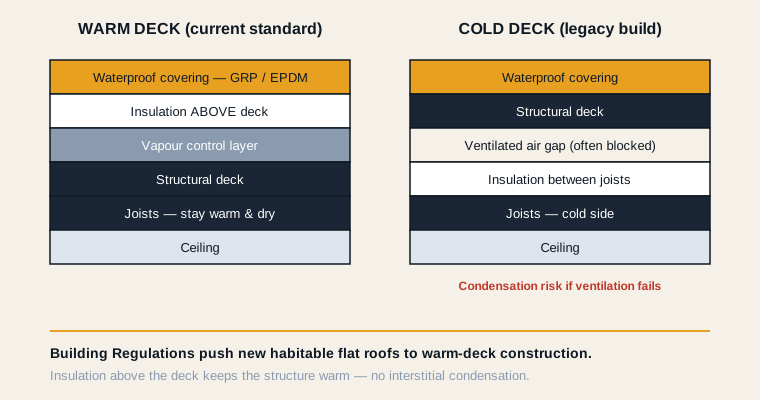
Ponding accelerates UV degradation of the membrane even on GRP (which is the most resistant system), promotes moss and algae growth, and adds structural load on the deck below. When we diagnose a ponding problem, the solution depends on whether the deck deflection is minor (addressable with tapered insulation to restore positive falls) or significant (requires deck replacement to restore structural integrity before re-roofing). We assess deck condition as part of every flat roof survey and include the correct remediation in the repair or replacement quote.
Emergency Flat Roof Repair in Derby
Flat roof emergencies in Derby fall into two categories: active leaks requiring immediate weatherproofing, and structural concerns following storm damage. For active leaks, we carry liquid EPDM repair compound, GRP patch materials and self-adhering butyl tape on every van for same-day temporary or permanent repair depending on the extent of the failure and weather conditions. For structural concerns — a flat roof section that has partially collapsed or shows signs of deck failure — we carry boarding materials for temporary protection while a replacement is arranged.
Flat roof emergency calls in Derby cluster around two seasonal peaks: late summer, when UV degradation and thermal movement cause blistering and split seams in older felt systems; and November–January, when freeze-thaw cycling opens up lap joints and causes catastrophic failure of felt that has been deteriorating through several previous winters. The November–January peak is more severe because the same rainstorm that reveals the failure then continues to drive water through it.
Choosing Between Repair and Replacement
The decision between repairing and replacing a flat roof in Derby should be based on the remaining membrane life and the extent of affected area. Our guidelines: if less than 25% of the membrane area is affected and the surrounding membrane is sound, repair is viable. If more than 25% is affected, or if the deck boards below have softened, or if the same flat roof has been repaired more than twice in the past 5 years, replacement gives better long-term value. We make this call explicitly in every survey and explain the reasoning — we have no financial incentive to recommend replacement when repair is the better choice, and we tell homeowners that clearly.
Honest advice
Do You Actually Need Flat Roof Repairs?
A leaking flat roof in Derby is often repairable — the trick is telling a localised failure from a covering that has reached the end of its life. We assess honestly and repair where a repair genuinely holds.
A single split, blister or lifted lap in otherwise sound felt
A leak that traces to one detail — an upstand, outlet or junction
Failed mastic around a rooflight or pipe penetration
When it is not the answer: If the deck is wet and soft or the covering is failing in several places at once, patching is throwing money at a roof that needs re-covering Read the full guide.
Flat Roof Repairs — technical referenceThe process
From First Call to Sign-Off
1. Survey and leak trace
We find where water actually enters — on a flat roof the leak is often distant from the internal stain.
2. Quote
A fixed price for the repair, with an honest note if the roof is near the point where re-covering is better value.
3. Scheduling
Most flat roof repairs are booked within days; active leaks get priority.
4. The repair
We repair the split, lap or detail with compatible materials and re-dress the failure properly rather than smearing mastic over it.
5. Test and sign-off
We check the repair holds and clear the site.
Timescales
Job Durations at a Glance
Job
Typical duration
Single split or lap repair
1–2 hours
Upstand or detail repair
2–3 hours
Rooflight/penetration reseal
1–2 hours
Localised patch and overlay
half a day
Temporary make-safe (active leak)
1 hour
Repairs and adhesives need a dry surface — we fit a temporary make-safe immediately and complete the permanent repair in the next dry window.
Access
Getting Safely onto Derby Roofs
Ground-floor flat roofs are reached from a ladder or tower; first-floor flat roofs may need edge protection. Scaffold is specified for: first-floor or high-level flat roofs where safe standing time is needed - always itemised in your written quote, never a hidden extra, and we arrange it.
Derby's mix of Victorian terraces, post-war estates and city-centre stock means access varies street by street, from tight terraced frontages to open estate roads. Pavement scaffold and skip permits go through Derby City Council; allow a few working days on streets like Sadler Gate, the Wardwick, Friar Gate where space is tight.
Pricing
Flat Roof Repairs Prices in Derby
Job
Typical range
Notes
Single split/lap repair
£150–£350
Localised
Upstand/detail repair
£200–£450
Per detail
Rooflight reseal
£150–£350
Per unit
Localised patch + overlay
£300–£600
Half-day
Temporary make-safe
£120–£250
Active leak
What moves the price
The extent of the failure — one detail vs several
Whether the deck beneath is dry or has been wetted
Access to the flat roof
The covering type and its remaining life
Whether a permanent repair or a re-cover is the better value
Worked example: Resealing a leaking upstand on an extension flat roof in Allestree — about £280 including access.
No deposit on flat-roof repairs — payment on completion. VAT included.
Covering DE1, DE21, DE22, DE23, DE24 and surrounding postcodes.
Guarantee
Your Guarantee, Explained
Flat roof repairs are guaranteed for workmanship; where a repair reveals the covering is beyond economic repair, we credit the assessment toward a re-cover.
Covered: workmanship for 10 years, in writing, transferable if you sell.
On top: manufacturer warranties on materials (terms vary by product).
Not covered: storm or impact damage - that is an insurance matter, and we will document it for your claim.
If a fault appears in covered work, we come back and put it right. No quibbling, no re-charge.
Questions about your roof? Call us free on 0133 240 5131 — no call-out fee, no obligation.
Good to know
Disruption, Mess & Weather
A quick, quiet job — usually an hour or two at the back of the property with almost no mess. You do not need to stay home for external work - we just need power and access agreed in advance.
A permanent flat roof repair needs a dry deck; if it is raining we make safe the same day and return to complete once dry. Derby's inland Midlands position brings genuine winter frosts and Derwent-valley humidity that slows drying.
FAQ
Frequently Asked Questions
Minor flat roof repairs — patching a blister, sealing a single leak point, clearing a blocked outlet — typically cost £150–£350. Larger failed sections requiring membrane replacement run £400–£900. If the repair cost exceeds 50% of a full replacement, we'll tell you and give you a replacement quote.
Blistering and cracking on ageing felt is the most common issue, particularly on the 1960s–70s garage and extension flat roofs that are now decades past their design life across Normanton, Spondon and Mackworth. Ponding water due to failed drainage falls is the second most frequent — often caused by roof deck deflection over time.
Yes, if the membrane is generally intact with a single failure point. We carry liquid EPDM repair compound and GRP patch materials on every van for isolated repairs. If the overall membrane condition is poor — cracked across a wide area or spongy to the touch — full replacement will last longer and cost less over 10 years than repeated patches.
If you can see a single blister, crack or joint failure and the surrounding membrane is sound, repair is the right call. If the felt is cracked or lifting across more than 25% of the surface, if the deck boards below feel soft, or if you've had the same section repaired more than twice, it's time to replace.
Flat roof leaks rarely appear directly above the internal damp patch — water travels along the deck before finding an entry point. Common failure locations are outlets and drains (the most frequent cause), lap joints between membrane sheets, upstand flashings where the roof meets a wall, and edges where the membrane terminates. We locate the failure before quoting the repair.
Minor emergency repairs — temporary weatherproofing, outlet clearing — can be carried out in wet conditions. Permanent repairs involving bonded membrane systems or GRP require dry conditions for proper adhesion. We'll apply temporary protection in wet weather and return for the permanent repair when conditions allow.
A correctly executed repair on an otherwise sound membrane should last 5–10 years. If the surrounding membrane is near end-of-life, the repair will outlast the membrane around it — at that point, full replacement becomes the better investment. We'll give you an honest assessment of remaining membrane life when we inspect.