GRP fibreglass, EPDM rubber and felt flat roofing for garages, extensions and outbuildings across Derby. Durable solutions designed to handle the city's freeze-thaw winters.
Flat roofing in Derby costs £600–£6,000 depending on system and area — GRP fibreglass, EPDM rubber or felt for garages and extensions. Derby Roofing Experts provide free quotes with deck assessment and a 10-year guarantee. Call 0133 240 5131.
Derby has a significant flat roofing problem. Large areas of the city's council and housing association stock — Spondon, Mackworth, Normanton — were built in the 1960s and 1970s with flat-roofed garages and rear extensions covered in original felt or early bitumen. That material has a design life of 10–15 years. Most of it is now 40–60 years old, and while it may not have failed catastrophically, it's almost certainly past the point where patching makes financial sense.
Derby's winter climate makes the choice of replacement material particularly important. Freeze-thaw cycles work into any joint or seam, and traditional felt systems with lapped joints can start failing within a decade. We recommend GRP fibreglass for almost all domestic flat roofs — it's seamless, handles thermal movement well, and carries a genuine 25-year material life. For larger commercial or housing association roofs, EPDM rubber is our preferred system for value and longevity.
“GRP flat roof on the garage in Normanton. Old felt had been leaking for years. Derby Roofing did the full job in a day, looks great, and they explained why GRP was the right choice for us.”
Barry L. · Normanton, Derby
★★★★★
“Extension flat roof had failed on our Mackworth estate house. Had three quotes — Derby Roofing were competitive and the only ones who checked the deck boards underneath before pricing. Honest company.”
Sarah V. · Mackworth, Derby
★★★★★
“Flat roof on the kitchen extension kept leaking no matter how many times it was patched. Full EPDM replacement sorted it permanently. Brilliant job.”
Nick T. · Oakwood, Derby
Why GRP is the Right Choice for Derby
GRP fibreglass flat roofing handles Derby's freeze-thaw climate better than any other flat roofing system for the simple reason that it has no joints. Traditional felt systems rely on lapped and bonded joints between membrane sheets — joints that expand and contract with every temperature cycle, eventually opening to allow water ingress. EPDM rubber has fewer joints but still has seams at edges and penetrations. GRP is installed as a single continuous surface: once cured, there is no joint to fail regardless of how many freeze-thaw cycles the Derby winter produces.
The practical result is that a GRP roof installed correctly in Derby will outlast its 25-year material warranty without any maintenance beyond an annual visual check. Felt roofs on Derby's 1960s–70s garages have failed after 10–15 years. Replacement felt installed in the 1980s–90s has failed again. GRP installed today on the same garage should still be performing in 2050.
Deck Assessment Before Installation
The deck — the wooden boarding that GRP is applied to — must be sound before installation. On garages and extensions where original felt has been leaking for years, the deck boards beneath are frequently softened or partially rotted due to moisture ingress. GRP applied to a compromised deck will delaminate as the deck continues to deteriorate beneath it. We assess deck condition before quoting and replace any affected sections — typically OSB18mm — as part of the installation cost. This is non-negotiable; skipping the deck assessment to reduce the quote produces a failed GRP installation within a few years.
Drainage Design
A flat roof that doesn't drain correctly will pond water. Standing water accelerates UV degradation even on GRP, promotes moss and algae growth, and adds structural load on the deck below. All GRP installations are designed with correct drainage falls built into the installation — either through the geometry of the existing structure or through the application of tapered insulation to create a positive fall to the outlet. We specify minimum 1:80 fall to all outlets as standard.
Upstand Heights and Abutment Details
The most commonly skipped detail on flat roof installations across Derby's post-war housing stock is upstand height at abutments — the vertical section of membrane that turns up the wall or parapet above the flat roof surface. Building regulations and GRP manufacturer specifications require a minimum 150mm upstand at all abutments. Upstands below this height allow wind-driven rain to pass behind the membrane at the wall junction, causing persistent damp penetration that is frequently misdiagnosed as a wall problem rather than a roofing defect. On properties where a flat roof abuts an existing wall — particularly the common kitchen extension arrangement on Derby's post-war semis — we measure and confirm upstand heights before quoting, and include the correct height in every GRP installation as standard.
Flat Roof Insulation Upgrades
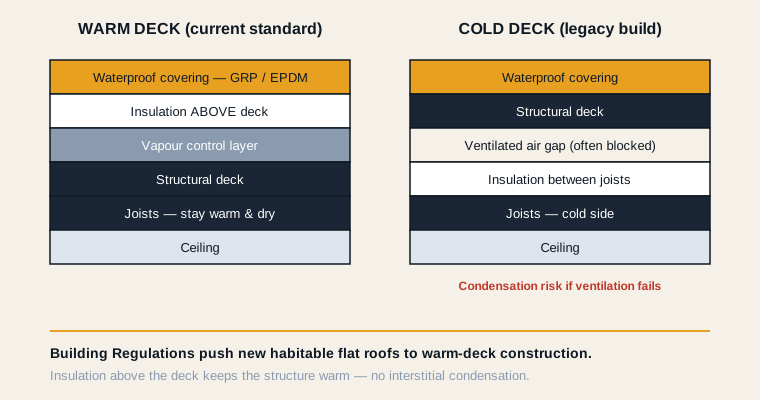
When a flat roof is being replaced, adding insulation above the deck is significantly cheaper than retrofitting it later. A warm roof configuration — insulation above the deck, beneath the waterproofing membrane — eliminates the condensation risk that cold roof configurations carry, improves the property's thermal performance, and can contribute to an EPC improvement. The additional cost over a standard GRP replacement is modest relative to the whole-job cost. We price warm roof and cold roof configurations on every flat roof replacement survey and present both options clearly so homeowners can make an informed choice.
Honest advice
Do You Actually Need Flat Roofing?
A failing flat roof on a Derby extension, garage or dormer usually shows as pooling water, blistering, or a leak below. Whether it needs re-covering or a repair comes down to the deck underneath.
Soft or springy patches underfoot indicating a wet deck
When it is not the answer: If the deck is sound and the failure is a single split or lifted lap, a repair buys real years and a full re-cover would be oversell Read the full guide.
Flat Roofing — technical referenceThe process
From First Call to Sign-Off
1. Survey and deck assessment
We check the covering and probe the deck — a sound deck supports a re-cover, a wet deck needs replacing first.
2. Specification and quote
A fixed price for the right system — EPDM rubber, GRP fibreglass or high-performance felt — matched to the roof's use and size.
3. Scheduling
Flat roofs are quick to programme; most domestic flat roofs are a 1–3 day job.
4. Installation
The old covering is stripped, deck repaired or upgraded, insulation addressed where needed, and the new seamless membrane laid and dressed into all details.
5. Handover with guarantee
We test the falls and outlets, clear the site, and hand over the guarantee.
Timescales
Job Durations at a Glance
Job
Typical duration
Garage flat roof (EPDM/GRP)
1–2 days
Extension flat roof
2–3 days
Dormer flat roof
1–2 days
Warm-deck upgrade (with insulation)
2–4 days
Flat roof repair
2–4 hours
GRP and some adhesives need dry conditions to cure — we schedule flat roofing around dry weather windows.
Access
Getting Safely onto Derby Roofs
Most Derby flat roofs are reached from a tower or ladder; scaffold is only needed where the flat roof is at height or wraps a two-storey elevation. Scaffold is specified for: first-floor and dormer flat roofs, or where edge protection is required at height - always itemised in your written quote, never a hidden extra, and we arrange it.
Derby's mix of Victorian terraces, post-war estates and city-centre stock means access varies street by street, from tight terraced frontages to open estate roads. Pavement scaffold and skip permits go through Derby City Council; allow a few working days on streets like Sadler Gate, the Wardwick, Friar Gate where space is tight.
Pricing
Flat Roofing Prices in Derby
Job
Typical range
Notes
Garage flat roof (EPDM/GRP)
£900–£1,600
Seamless, 20yr+ life
Extension flat roof
£1,800–£4,000
Size dependent
Dormer flat roof
£800–£1,800
Per dormer
Warm-deck upgrade
+£400–£900
Adds insulation board
Flat roof repair
£150–£400
Localised
What moves the price
The system — felt is cheapest, EPDM and GRP cost more but last far longer
Roof size and the number of upstands, outlets and details
Whether the deck needs replacing before re-covering
Whether a warm-deck insulation upgrade is wanted or required
Access — ground-floor vs first-floor or dormer level
Worked example: An EPDM re-cover on a single garage in Littleover — about £1,150 including strip, new deck where needed and dressed edges.
No deposit on flat-roof repairs under £500. Staged payment on full re-covers, balance on completion. VAT included in every quote.
Covering DE1, DE21, DE22, DE23, DE24 and surrounding postcodes.
Guarantee
Your Guarantee, Explained
Flat roof installations carry a 10-year workmanship guarantee; EPDM and GRP systems carry manufacturer warranties of 20–25 years and more on top.
Covered: workmanship for 10 years, in writing, transferable if you sell.
On top: manufacturer warranties on materials (terms vary by product).
Not covered: storm or impact damage - that is an insurance matter, and we will document it for your claim.
If a fault appears in covered work, we come back and put it right. No quibbling, no re-charge.
Questions about your roof? Call us free on 0133 240 5131 — no call-out fee, no obligation.
Good to know
Disruption, Mess & Weather
Flat roof work is low-disruption — a day or two of quiet work at the back of the house, minimal debris, and no need to be home for external work. You do not need to stay home for external work - we just need power and access agreed in advance.
Flat roofing needs dry conditions for the membrane to bond and cure, so we watch the forecast and never lay onto a wet deck; the Derwent valley's autumn humidity slows GRP curing, which we allow for. Derby's inland Midlands position brings genuine winter frosts and Derwent-valley humidity that slows drying.
FAQ
Frequently Asked Questions
Garage flat roof replacement typically costs £800–£1,800 depending on size and material. Extension flat roofs run £1,200–£4,000. All quotes are free and fixed — what we quote is what you pay.
GRP fibreglass is our top recommendation for Derby. It handles freeze-thaw cycles better than felt, is seamless with no joints to fail, and has a 25-year material life. EPDM rubber is a strong alternative for larger areas and housing association stock.
Most flat roof failures in Derby are on 1960s–70s garages and extensions that were felted at construction. Original felt has a 10–15 year life and most of it is now 40–60 years old. Derby's frost cycles accelerate joint failure and blistering compared to milder UK climates.
If the felt is generally sound with a single blister or minor leak, repair can be viable. If the surface is cracked across a wide area or the deck below has softened, replacement is the better investment. We'll give you an honest assessment on inspection.
GRP fibreglass flat roofs can be walked on with care — they're structurally sound and fully trafficable. Felt and EPDM roofs should not be walked on routinely as shoe pressure can puncture or stress the membrane. If you need regular access to a flat roof, we can specify a GRP system with a non-slip surface.
Replacing a flat roof like-for-like does not require planning permission. Raising the height of the roof structure or changing its profile may require permitted development approval. For properties in Derby's conservation areas, material changes require consent even on flat roofs.
GRP fibreglass is seamless — there are no joints to fail. It handles Derby's freeze-thaw cycles better than felt, which relies on lapped joints that can separate with thermal movement. GRP also has a 25-year material life vs 10–15 years for standard felt. On Derby's 1960s–70s garage and extension stock, GRP replacement is always our recommendation.