Lead flashings, valleys, parapet capping and lead roofing for period and modern properties across Derby. Specialists in the chimney and valley lead work that Derby's Victorian and Edwardian housing demands.
Lead roofing in Derby costs £400–£2,000 — chimney flashings, valley linings, bay roofs and parapet capping in Code 4 or 5 lead. Derby Roofing Experts never use sub-standard lead code. Call 0133 240 5131 for a free quote.
Lead Work Specialists
Lead Roofing Across Derby
Lead remains the benchmark material for chimney flashings, roof valleys, parapet capping and bay window roofing on both period and modern properties. When installed correctly to the correct Code specification, lead outlasts every alternative — a properly dressed lead flashing should give 60+ years of service. The problem is that lead is also the most commonly bodged roofing material: mastic, silicone, self-adhesive flashing tape and bitumen are regularly used as temporary patches that become permanent, masking an underlying failure for 3–5 years before failing themselves.
Derby's Victorian and Edwardian housing stock around Friar Gate, the Cathedral Quarter, Darley Abbey and the older village cores of Duffield and Melbourne has a high density of lead work. Chimney stack flashings, lead-lined valleys in Welsh slate roofs, and bay window lead roofing are all common on this stock. Derby's frost cycles are hard on lead — north-facing work is particularly vulnerable to freeze-thaw working the lead out of its mortar chase year by year. We carry Code 4 and Code 5 lead sheet on every van and cut and dress on site to the correct specification.
Lead Work Pricing Guide
Chimney Flashing Repair
£200–£450
Re-dress existing lead, re-point chase
Chimney Flashing Replace
£350–£700
Full lead strip and relay, Code 4 lead
Lead Valley Replace
£500–£1,200
Strip and relay, Code 4 or 5 lead
Bay Window Lead Roof
£600–£1,400
Full lead replacement, dressed to walls
No Mastic, No Tape
We don't use mastic, silicone or self-adhesive flash tape as permanent lead repairs. These materials have a short service life and mask the extent of underlying failure. All our lead work is code-correct and dressed to the Lead Sheet Association specification.
Customer Reviews
What Do Our Customers Say?
★★★★★
“Lead valley had been patched twice with mastic before we called Derby Roofing. They stripped the lot and relaid Code 5 lead to the full length. No more leaks and it looks as it should.”
Robert P. · Friar Gate, Derby
★★★★★
“Bay window lead roof on our Victorian terrace had been leaking into the front bedroom for two winters. Full replacement in a morning. The finish is properly dressed and clean.”
Mary K. · Cathedral Quarter, Derby
★★★★★
“Chimney flashing on our Darley Abbey cottage — needed to match the quality of the original. Derby Roofing used Code 4 lead and dressed it correctly to the stack. Excellent work.”
George A. · Darley Abbey, Derby
Why Lead Remains the Benchmark Material
Despite the availability of lead-alternative products — Leadax, Wakaflex, self-adhesive flash tape, liquid flashing compounds — traditional lead sheet remains the benchmark material for chimney flashings, roof valleys and parapet capping for one simple reason: longevity. A Code 4 lead installation correctly executed has a design life of 60–80 years. Lead-alternative products have design lives of 15–25 years in best-case manufacturer claims, with real-world performance typically shorter in Derby's freeze-thaw climate. Over a 60-year window, a single lead installation costs less than three lead-alternative replacement cycles.
The exception is complex geometry: lead is a skilled trade and very tight internal angles, complex abutment geometries or multi-plane intersections can be difficult to execute correctly in lead without very high skill levels. In these situations, cold-applied EPDM liquid flashing or Leadax can be the right specification — not as a cost-saving measure but as the technically correct solution for the geometry involved. We advise on the right material for each specific application.
Code Specification and Why It Matters
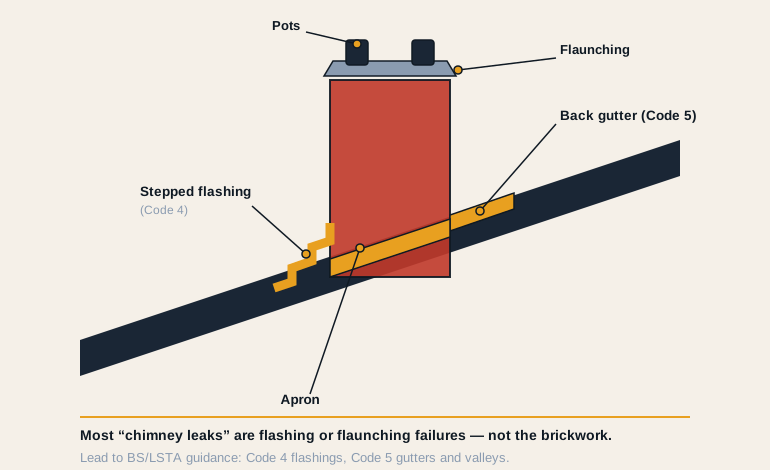
Lead sheet is specified by code number corresponding to its weight and thickness: Code 3 (1.32mm), Code 4 (1.80mm), Code 5 (2.24mm), Code 6 (2.65mm). For chimney step flashings and soakers on domestic properties, Code 4 is the correct minimum specification. Code 3 is lighter and cheaper but has a significantly shorter service life — thermal movement in Derby's winters works thin lead harder and accelerates fatigue cracking. We never use Code 3 for chimney flashing work on Derby residential properties; the cost saving is outweighed by the reduction in service life.
Code 5 is used for apron flashings — the single-piece flashing that runs across the full width of a chimney at the lower junction with the roof — and for valley linings and parapet capping where the greater width means more thermal movement to accommodate. Code 6 is used for flat lead roofing on bay windows and Victorian extensions where the larger area creates higher thermal stress and the extra thickness provides better fatigue resistance.
The Mastic Problem in Derby
Mastic and silicone sealants applied to lead flashings as a patch repair are among the most common findings on Derby's older housing stock. The pattern is consistent: a lead flashing begins to lift or crack, a previous roofer applies mastic as a temporary fix, the mastic lasts 3–5 years before it hardens and cracks itself, the homeowner calls us with a leak and we find the original lead failure still present beneath two or three layers of mastic application. The mastic has extended the apparent life of the flashing by masking the failure without addressing it.
When we find mastic-patched flashings on Derby properties, the correct approach is to strip the mastic, assess the underlying lead condition, and either re-dress if the lead is sound or replace if the lead has cracked or thinned beyond usefulness. Applying further mastic over existing mastic is not a repair we carry out — it creates the same 3–5 year cycle that brought the homeowner to us in the first place.
Honest advice
Do You Actually Need Lead Roofing?
Lead is the traditional weatherproofing for the vulnerable junctions of Derby's older roofs — flashings, valleys, bay and porch roofs, parapet gutters. When it fails, water gets into the most awkward parts of the roof.
A damp patch where the roof meets a wall, chimney or parapet
Lead flashing lifted, cracked, or pulled out of the mortar joint
A leaking lead bay or porch roof on a Victorian property
Splits in an over-long run of lead from thermal movement
When it is not the answer: If a flashing has simply lifted from the mortar and the lead is sound, re-dressing and re-pointing it is enough — full renewal would be oversell Read the full guide.
Lead Roofing — technical referenceThe process
From First Call to Sign-Off
1. Lead inspection
We assess the lead's code, condition and detailing — much failure is from wrong-code or over-long lead installed cheaply.
2. Specification quote
A fixed price to renew in correct-code lead with traditional detailing.
3. Scaffold and access
Safe access is arranged for the leadwork.
4. Strip and re-dress
Failed lead is stripped and renewed in correct-code lead — Code 4/5 for flashings and valleys — with welted joints and correct sizing for thermal movement.
5. Watertight guarantee
We confirm the detail is weathertight and hand over the guarantee.
Timescales
Job Durations at a Glance
Job
Typical duration
Renew a flashing
half a day
Lead valley renewal
1–2 days
Bay/porch roof re-lead
1–2 days
Parapet gutter re-line
2–3 days
Heritage leadwork (complex)
2–4 days
Lead is dressed on site and needs workable conditions — heavy rain pauses the work.
Access
Getting Safely onto Derby Roofs
Leadwork needs safe standing time, so scaffold or a secure tower is arranged for most jobs beyond a simple flashing. Scaffold is specified for: valleys, bay roofs, parapet gutters and any leadwork needing sustained standing time - always itemised in your written quote, never a hidden extra, and we arrange it.
Derby's mix of Victorian terraces, post-war estates and city-centre stock means access varies street by street, from tight terraced frontages to open estate roads. Pavement scaffold and skip permits go through Derby City Council; allow a few working days on streets like Sadler Gate, the Wardwick, Friar Gate where space is tight.
Whether it is a simple flashing or complex bay/parapet work
Heritage detailing and matched materials
How much associated covering must be lifted and relaid
Worked example: Renewing a lead valley on a Victorian slate terrace in Peartree — around £950 including access.
Staged payment on larger leadwork, balance on completion. No large deposit. VAT included.
Covering DE1, DE21, DE22, DE23, DE24 and surrounding postcodes.
Guarantee
Your Guarantee, Explained
Leadwork carries a 10-year workmanship guarantee; correctly-installed lead to BS EN 12588 lasts 60–100 years, far outlasting the cheap alternatives it often replaces.
Covered: workmanship for 10 years, in writing, transferable if you sell.
On top: manufacturer warranties on materials (terms vary by product).
Not covered: storm or impact damage - that is an insurance matter, and we will document it for your claim.
If a fault appears in covered work, we come back and put it right. No quibbling, no re-charge.
Questions about your roof? Call us free on 0133 240 5131 — no call-out fee, no obligation.
Good to know
Disruption, Mess & Weather
Contained work at the roof junctions, some access scaffold, and minimal disruption inside — most leadwork is invisible from the ground once done. You do not need to stay home for external work - we just need power and access agreed in advance.
Lead can be worked in most conditions but is dressed and detailed best in the dry; correctly-sized lead with expansion joints handles Derby's temperature swings without splitting. Derby's inland Midlands position brings genuine winter frosts and Derwent-valley humidity that slows drying.
FAQ
Frequently Asked Questions
Lead flashing replacement around a single chimney stack typically costs £350–£700 in Derby. Full lead valley replacement runs £500–£1,200 depending on valley length. Lead parapet capping and bay window lead work is priced on inspection. All quotes free.
Derby's freeze-thaw cycles are the primary cause. Water gets into any small gap in the lead chase or pointing, freezes and expands, and over successive winters works the lead progressively looser. North-facing chimney stacks and valleys in the shade are worst affected — they cycle through freeze-thaw without the thermal recovery that south-facing elements get.
Lead can be re-dressed if it's lifted but undamaged. If it's been repeatedly patched with mastic or silicone — which happens frequently on older Derby properties — the correct approach is full replacement: mastic patches break down within 3–5 years and mask the extent of the underlying failure.
Yes. Lead roofing — flat lead roofs on bay window extensions, Victorian extensions and outbuildings — is a specialist skill and we carry it out to Code 4/5 lead specification. We work on period properties in Friar Gate, Darley Abbey, Cathedral Quarter and the conservation areas around Duffield and Melbourne.
Code 4 lead (1.8mm thickness) is the standard specification for chimney step flashings and soakers on domestic properties. Code 5 (2.24mm) is used for apron flashings and larger areas subject to greater thermal movement. We never use Code 3 or lighter for chimney work — it's a false economy that leads to early failure.
Correctly installed Code 4 lead has a design life of 60–80 years. The failure we see on Derby properties is almost always due to: inadequate code specification (too thin), improper fixing into the mortar chase, or previous patch repairs with mastic that have masked progressive failure. A new lead installation done correctly should outlast the next two owners of the property.
Lead-effect products such as Leadax or Wakaflex are appropriate for some applications — particularly complex geometry where traditional lead is difficult to work. For chimney flashings and valley work on Derby period properties, traditional lead is still the correct and most durable choice. We advise on the right specification for each application.