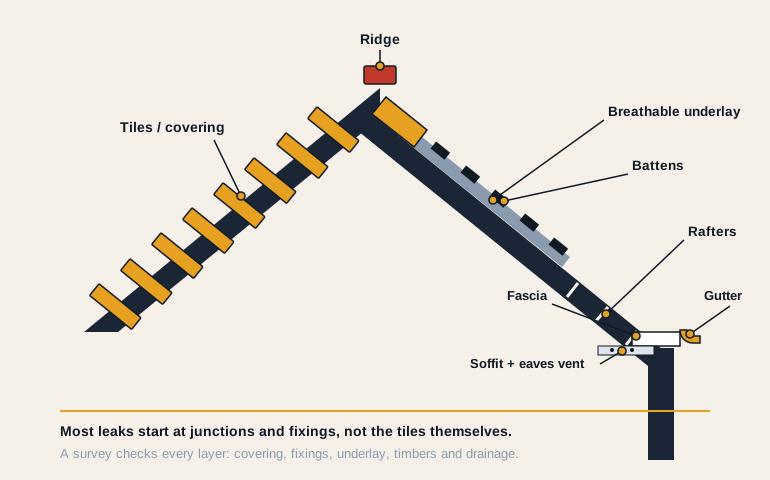
Ridge, verge, hip and chimney repointing across Derby. The most in-demand roofing job on Derby's 1960s–70s estates — and the correct fix before loose tiles become a leak or an emergency call-out.
Roof repointing in Derby costs £400–£1,000 — ridge, verge and hip mortar in correct flexible or lime specification. Derby Roofing Experts provide a 10-year guarantee on all repointing. Call 0133 240 5131 for a free quote.
Repointing Specialists
Roof Repointing Across Derby
Roof repointing — specifically the re-bedding and repointing of ridge, verge and hip tiles — is the single most in-demand roofing job across Derby right now. Mackworth, Normanton, Chaddesden, Derby Hill and Spondon all have large concentrations of 1960s concrete interlocking tile housing where the original mortar has reached the end of its 60–80 year design lifespan. The tiles are fine; the mortar holding them in place is not.
A properly executed repoint uses flexible roofing mortar — not standard cement sand mix — and involves raking out all of the failed existing mortar before applying fresh material. Repointing over the top of failed mortar without proper preparation is a false economy: the new material has nothing sound to bond to and will fail within a few years. We rake out and clean all surfaces before applying the new mortar as standard on every repointing job.
Repointing Pricing Guide
Ridge (Semi)
£400–£700
Full ridge rake-out and repoint
Verge (Both Ends)
£150–£300
Gable end verge repoint
Hip Repoint
£200–£450
Per hip, rake-out and repoint
Chimney Stack
£200–£500
Full stack repoint, all faces
Customer Reviews
What Do Our Customers Say?
★★★★★
“Ridge and verge repoint on our 1965 Normanton semi. They raked out the full ridge before starting — not just pointing over the top of the old mortar. Proper job.”
Beverley H. · Normanton, Derby
★★★★★
“Chimney repoint in lime mortar on our Victorian Friar Gate property. Correct specification for the age of the building. Very satisfied.”
Christopher W. · Friar Gate, Derby
★★★★★
“Full ridge, verge and both hips on our Mackworth estate house. Done in a day. The quote was exactly what we paid. Would recommend.”
Anne G. · Mackworth, Derby
The Mortar Specification Question
Not all roofing mortar is the same, and the specification used matters significantly for longevity. Standard cement and sand mortar — 3:1 or 4:1 mix — was used on most of Derby's post-war roofing and is what produced the 60–80 year lifespan that is now expiring simultaneously across the city's 1960s–70s estates. It is rigid, brittle when cured, and susceptible to the thermal movement and freeze-thaw cycling that Derby's winters produce.
Modern flexible roofing mortars include polymer additives that give the cured mortar a degree of flexibility, allowing it to accommodate thermal movement without cracking. On Derby's exposed western suburbs — Mickleover, Ripley, the higher Derbyshire plateau locations — a flexible mortar specification makes a measurable difference to longevity compared to a standard cement mix. We use flexible mortar specification on all repointing work as standard.
For pre-1919 properties in Darley Abbey, Friar Gate and the conservation areas, lime mortar is the correct specification — not cement, not polymer-modified cement. Lime mortar is breathable, flexible, and appropriate for the masonry it bonds to. Cement mortar on Victorian sandstone or brick accelerates masonry decay by trapping moisture. We carry lime mortar on every van and use it automatically on period properties without needing to be asked.
Identifying Whether You Need Repointing or Dry Fix
For Derby properties that have already had one repoint and are approaching the next, dry ridge and dry verge systems offer a permanent mechanical alternative to further mortar maintenance. The choice depends on condition and preference: if the tiles are in good condition and the homeowner wants a low-maintenance permanent fix, dry fix is the better long-term investment. If the roof has visible tile damage that needs addressing alongside the mortar work, a full replacement is worth considering instead of either option.
We make this assessment honestly on every repointing survey. We carry both flexible mortar and dry fix components and can quote both options where appropriate, with a clear recommendation based on the specific property's condition and position.
Access and Safety
Safe repointing requires working from a scaffold-secured platform at ridge level — not from a ladder leant against the roof. The ridge of a 3-bed Derby semi is typically 5–6 metres above ground level, well above the safe working height for a leaning ladder. We include scaffold hire in all repointing quotes and never work from unsecured ladders at ridge height. Any contractor quoting for ridge repointing without mentioning access arrangements should be asked specifically how they plan to reach the ridge safely.
Repointing Sequence and Weather Windows
Mortar-based repointing work in Derby requires surface temperatures above 5°C during application and for the first 24 hours of cure. This creates scheduling constraints through December and January on the coldest sites — north-facing ridges and exposed western-aspect properties in Mickleover, Ripley and the plateau locations. We schedule repointing work with weather awareness and don't apply mortar in conditions where the cure will be compromised. Flexible polymer-modified mortar has a slightly wider temperature tolerance than standard cement mix, which is one of several reasons we specify it as standard. In practice, most planned repointing work across Derby can be carried out year-round with appropriate scheduling; only the coldest spells in the harshest exposed positions require deferral.
Post-Repoint Inspection
On completion of any repoint, we carry out a full visual check from working height before descending — checking joint depth, surface finish, and confirming no tiles have been displaced or damaged during the work. A written record of the repoint is provided on every job, including the mortar specification used and the date of completion. This record is useful for future maintenance planning and for property sale documentation. We recommend a light inspection after the first winter to confirm the mortar has cured well and no joint cracking has occurred at thermal movement points.
Honest advice
Do You Actually Need Roof Repointing?
Repointing renews the mortar bedding the ridge and verge tiles on a Derby roof. On the city's post-war estates, sand-cement mortar reaches the end of its life together, street by street, and starts dropping out.
A ridge that looks patchy and eroded against the sky
When it is not the answer: If the mortar has already failed once and been repointed, a permanent dry-fix system is better value than repointing a third time — we will explain the choice Read the full guide.
Roof Repointing — technical referenceThe process
From First Call to Sign-Off
1. Inspection
We assess the ridge and verge mortar and the tiles it beds.
2. Quote
A fixed price to re-bed, with an honest comparison against a permanent dry-fix system.
3. Scaffold and access
Safe access to the ridge is arranged.
4. Rake out and re-bed
Failed mortar is removed and the ridge and verge tiles re-bedded in fresh mortar — or dry-fixed if you choose the permanent option.
5. Sign-off
The ridge is left secure and weathertight.
Timescales
Job Durations at a Glance
Job
Typical duration
Re-bed a ridge line
1–2 days
Repoint verges
half a day–1 day
Ridge + verge re-bed
1.5–2.5 days
Convert to dry ridge instead
1–2 days
Assessment only
1–2 hours
Fresh mortar must not freeze — Derby's winter frosts mean we time repointing for mild, dry conditions.
Access
Getting Safely onto Derby Roofs
Ridge and verge work needs scaffold or a secure tower for safe access along the roof apex and edges. Scaffold is specified for: all ridge and verge work — the roof apex cannot be worked safely from a ladder - always itemised in your written quote, never a hidden extra, and we arrange it.
Derby's mix of Victorian terraces, post-war estates and city-centre stock means access varies street by street, from tight terraced frontages to open estate roads. Pavement scaffold and skip permits go through Derby City Council; allow a few working days on streets like Sadler Gate, the Wardwick, Friar Gate where space is tight.
Pricing
Roof Repointing Prices in Derby
Job
Typical range
Notes
Re-bed a ridge line
£400–£900
Per run
Repoint verges
£200–£500
Per gable
Ridge + verge re-bed
£600–£1,200
Combined
Convert to dry ridge
£400–£900
Permanent
Assessment
Free
With quote
What moves the price
Length of ridge and verge
Scaffold or tower access
Repoint vs permanent dry-fix
Tile profile and matching
Whether it is a first repoint or a repeat failure
Worked example: Re-bedding a failed ridge line on a 1960s semi in Mackworth — about £650, or £780 to convert to permanent dry ridge.
No large deposit; payment on completion for smaller jobs, staged on larger. VAT included.
Covering DE1, DE21, DE22, DE23, DE24 and surrounding postcodes.
Guarantee
Your Guarantee, Explained
Repointing carries a 10-year workmanship guarantee; where you choose a dry-fix system, it is mechanically fixed to BS 8612 and maintenance-free for the life of the tiles.
Covered: workmanship for 10 years, in writing, transferable if you sell.
On top: manufacturer warranties on materials (terms vary by product).
Not covered: storm or impact damage - that is an insurance matter, and we will document it for your claim.
If a fault appears in covered work, we come back and put it right. No quibbling, no re-charge.
Questions about your roof? Call us free on 0133 240 5131 — no call-out fee, no obligation.
Good to know
Disruption, Mess & Weather
Scaffold for access, some dust during raking out (sheeted), and a clean, secure ridge left behind. You do not need to stay home for external work - we just need power and access agreed in advance.
Repointing needs dry, frost-free conditions to cure; on Derby's exposed estate roofs we often recommend dry-fixing instead, which is weatherproof immediately and permanent. Derby's inland Midlands position brings genuine winter frosts and Derwent-valley humidity that slows drying.
FAQ
Frequently Asked Questions
Ridge repointing on a standard 3-bed Derby semi costs £400–£800. Verge repointing adds £150–£300. Chimney stack repointing runs £200–£500 depending on stack height. Combined ridge, verge and chimney repoint on a semi is typically £700–£1,200. Free quotes on all work.
Ridge repointing replaces the failed mortar with fresh mortar — it will last 15–25 years before needing attention again. Dry ridge eliminates mortar entirely, using mechanical fixings that will last the life of the tiles. For Derby properties that have already been repointed once, dry ridge is the permanent alternative.
On Derby's 1960s–70s concrete tile estates, the original mortar lasted 55–65 years. A repoint using modern flexible mortar should last 20–30 years. Properties in exposed positions — Mickleover, Ripley, the elevated western suburbs — may see slightly shorter intervals due to wind and frost exposure.
Often yes. Look at the ridge line — if tiles are sitting unevenly, if you can see gaps in the mortar between tiles, or if the verge tiles at the gable end are showing open joints below them, the mortar is failing. Binoculars help. Any of these signs warrant a professional inspection before the tiles start to shift.
We use a flexible roofing mortar formulated for ridge and verge applications. Standard cement sand mortar is too rigid and fails faster due to thermal movement. The flexible specification handles Derby's freeze-thaw cycles better and lasts significantly longer than a standard cement repoint.
Yes. Chimney stack repointing is one of our most common jobs on Derby's Victorian and Edwardian stock. We use lime mortar on pre-1919 properties — appropriate for the age and type of masonry — and flexible cement mortar on post-war stacks.
The access isn't — working safely on a roof ridge requires proper scaffold or specialist access equipment. The mortar specification matters too — a DIY repoint with the wrong mix will fail significantly faster than a professional repair. We don't recommend DIY roof repointing.