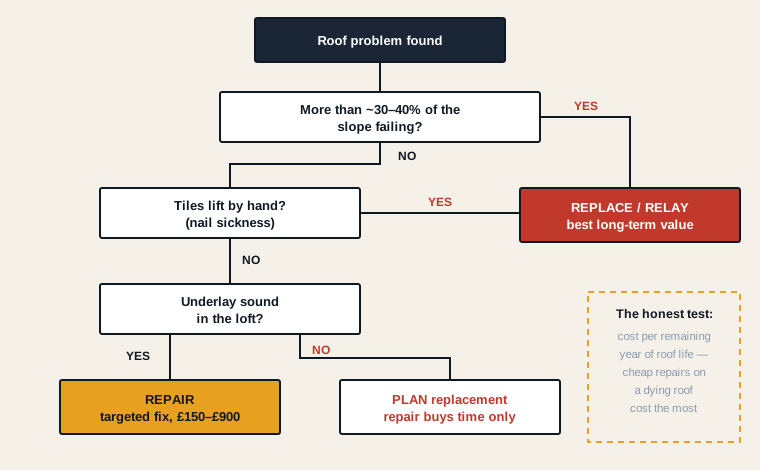
An honest decision framework for Derby homeowners weighing a roof repair against a full replacement — how age, condition and the pattern of failure decide it, the rules of thumb roofers actually use, and when each option is the wrong one.
Tell us the job in 30 seconds. No pushy sales, no call-out fee.
📞 Call Now: 0133 240 5131Repair when failures are localised and the roof structure, battens and underlay are sound; replace when failure is widespread, the covering has reached the end of its life, or repeated repairs no longer hold. A useful rule of thumb: if more than about 30% of the covering has failed, replacement is usually the better spend. Call 0133 240 5131 for an honest assessment.
The single most useful question is not how old the roof is — it is whether the failure is localised or widespread. A roof with one slipped slate, one failed flashing, or one leaking valley is a repair, whatever its age. A roof shedding slates across every slope, with failed underlay and perished battens showing, is telling you it has reached the end of its life. Age matters, but the pattern of failure matters more.
This guide is deliberately honest both ways, because the two ways a homeowner gets this wrong are equal and opposite. One is patching a roof that is genuinely finished — spending good money on repairs that will not hold while the real problem spreads. The other is being sold a full re-roof on a roof that had a decade of life left and needed a repair. A roofer worth trusting will steer you off both.
There is also a third factor beyond age and failure pattern: what you plan to do with the property. If you are selling soon, a sound repair that makes the roof watertight and presentable may be the sensible spend, and a buyer’s survey will assess the roof on its condition. If this is your forever home, investing in a replacement that lasts half a century can be better value than a series of repairs over the same period. The right answer weighs the roof’s condition against your own plans, which is why an honest roofer asks about both.
Derby's housing gives fairly clear signals by era. On the Victorian slate terraces of Normanton and Peartree, the classic pattern is nail sickness — the Welsh slate is often still excellent, but the iron nails holding it have rusted through, so slates slip across the whole roof. Here the honest answer is frequently a strip-and-relay: the roof is 'replaced' but your original slate goes back on over new membrane and battens with stainless fixings, at less cost than all-new slate, resolving the problem for another century.
On the post-war concrete-tile estates — Mackworth, Sinfin, Chaddesden — the tiles themselves often have plenty of life, and the recurring failure is the ridge and verge mortar. That is a repair or a dry-fix upgrade, not a re-roof. On 1930s semis in Littleover and Allestree, interlocking concrete tiles reaching 50-plus years and starting to delaminate or spall across the roof is a genuine replacement signal. Knowing the stock is half of reading the roof correctly.
A few practical tests cut through it. The 30% rule: if more than roughly a third of the covering has failed or is failing, repairing tile-by-tile is usually money wasted and replacement is the better value — below that, a repair is normally the right call. It is a rule of thumb, not a law, but it captures the point where patching stops making sense.
Cost-per-remaining-year: weigh what a repair costs against how many years it realistically buys, versus what a replacement costs against its 40-to-60-year life. A £400 repair that buys two years on a failing roof is worse value than it looks; a £400 repair that buys fifteen years on a sound one is excellent. The repeat-repair test: if you have already repaired the same roof two or three times and it keeps failing somewhere new, the roof is telling you it is finished — stop repairing and replace.There is a third option many homeowners do not know exists, and it is often the right one for Derby's older slate roofs: strip and relay. Instead of buying all-new slate or tile, the roof is stripped, a new breathable membrane and treated battens are fitted, and your original covering is relaid over them with new stainless or copper fixings. Sound slate and many concrete tiles are entirely reusable — typically 70 to 85 per cent of a well-aged Welsh slate roof goes back on.
This resolves the underlying problem — the failed felt, the perished battens, the rusted nails causing nail sickness — while saving the substantial cost of new materials. On a Victorian terrace in Normanton or Peartree where the slate is still excellent but everything holding it up has failed, a strip-and-relay is frequently better value than either endless repairs or a full new-material re-roof. It is neither a patch nor an oversell; it is the honest engineering answer, and it typically saves 25 to 40 per cent against a full replacement in new materials.
It does not suit every roof — if the slate or tile itself has genuinely failed, it must be renewed — but it is always worth asking about. A roofer who never mentions strip-and-relay on a nail-sick slate roof is either not looking properly or is quietly steering you toward the more expensive job.
Roof-condition decisions should weigh the extent and pattern of failure and the condition of the underlying structure, not age alone; independent stock-condition guidance treats widespread covering failure and degraded substrate as the replacement trigger.
— RICS / BRE stock-condition guidance
Repair when failures are localised and the structure is sound; replace when failure is widespread or the covering has reached end of life. The pattern of failure matters more than the roof's age.
If more than roughly a third of the roof covering has failed or is failing, replacement is usually better value than repairing tile-by-tile. Below that, a repair is normally the right call.
Often yes — nail sickness means the slate is usually still good but the fixings have failed. A strip-and-relay reuses your original slate over new membrane and battens with stainless fixings, at less cost than all-new slate.
Usually not — on Derby's post-war concrete-tile estates the tiles often have plenty of life and only the ridge and verge mortar has failed, which is a repair or dry-fix upgrade, not a re-roof.
If they quote a full re-roof without inspecting the loft or explaining specifically why a repair won't do, be cautious. A sound roof with one or two localised failures needs a repair, not replacement.
A properly installed new roof typically lasts 40–60 years or more depending on the material, which is what makes replacement good value once a covering has genuinely failed across the roof.
Yes — we give the honest version both ways, steering you off wasted repairs on a finished roof and off an unnecessary re-roof on a sound one. Call us for a straight assessment.
“Told us straight our Normanton slate roof needed a strip-and-relay, not all-new slate — reused our own slate and saved us thousands. Honest advice.”
— Michael T., Normanton“Another firm quoted a full re-roof; these confirmed it was just the ridge mortar on our Mackworth semi. Repaired for a fraction. Trustworthy.”
— Lisa R., Mackworth“Explained the 30% rule and showed me in the loft exactly why our roof was finished. No pressure, just the facts. Went ahead with confidence.”
— Andrew K., LittleoverCallback within 2 hours (8am–6pm, Mon–Sat), or at a time that suits you.
📅 Get My Free Quote 📞 0133 240 5131Free quotes, no call-out fee, 10-year guarantee.
📞 0133 240 5131Questions about your roof? Call us free on 0133 240 5131 — no call-out fee, no obligation.