⚡ 24/7 Emergency Roofing — 0133 240 5131
Cost Guide · Derby & Derbyshire

How Much Does a New Roof Cost in Derby?

An honest 2026 price guide for a full re-roof in Derby — by material, by property size, with every cost driver explained. Free survey and fixed written quote, no obligation.

📞 Call Now: 0133 240 5131

Tell us the job in 30 seconds. No pushy sales, no call-out fee.

20+
Years Local
127
5★ Reviews
24/7
Emergency
10yr
Guarantee
A new roof in Derby costs £5,800–£10,000 for a concrete-tile re-roof on a 3-bed semi, and £9,500–£16,000 in natural Welsh slate. Per square metre that is roughly £75–£145/m² for concrete tile and £180–£300/m² for slate. All prices include scaffold, membrane, battens and waste. Call 0133 240 5131.
NFRC Standards
Fully Insured
10-Year Guarantee
Free Quotes
No Hidden Costs

What a New Roof Costs in Derby in 2026

A full re-roof on a typical Derby 3-bed semi costs £5,800–£10,000 in concrete interlocking tile and £9,500–£16,000 in natural Welsh slate. Derby sits slightly below the national average because the Midlands labour market runs around 10–15% under London and the South East. Per square metre, expect roughly £75–£145/m² for concrete tile, £160–£250/m² for clay, and £180–£300/m² for Welsh slate, supplied and fitted.

Those figures are complete prices: they include scaffold erection and strike, a new breathable membrane, treated battens to BS 5534, ridge and verge work, lead flashings to chimneys and abutments, and waste removal by skip. A quote that comes in dramatically lower has usually left one of those elements out — most often the scaffold or the membrane grade — to reach a tempting headline number.

What Moves the Price on a Derby Re-Roof

Four things move a re-roof quote. Roof size and pitch come first: a larger or steeper roof needs more material and more labour. Covering material is second, and it is the biggest single lever — slate costs roughly double concrete tile. Access is third: scaffold is a fixed cost whether you do one elevation or the whole roof, which is why doing everything in one visit is more economical per elevation. Timber condition is fourth, and it is the one that catches people out.

Battens, sarking and rafter ends are only fully visible once the old covering is off. A quote that hasn't assessed them is provisional, and mid-strip surprises push the final bill up. We survey from roof level before quoting on every Derby re-roof and include any timber findings in the fixed price, so the number you agree is the number you pay.

Worked Example: A 1960s Semi in Mackworth

Take a typical three-bedroom concrete-tile semi on the Mackworth estate — one of Derby's large 1960s developments. The original interlocking concrete tiles are sound but the sand-cement bedding on the ridge has failed and the felt underlay has perished. A full re-roof reusing the sound tiles over new membrane, battens and dry-fixed ridge comes in around £6,200–£7,500 including scaffold and waste.

The same property with tiles too far gone to reuse, needing full new concrete tiles, runs closer to £8,000–£10,000. And a Victorian slate terrace off Kedleston Road needing a full Welsh slate re-slate with stainless fixings sits in the £10,000–£14,000 range because of the material cost. The single biggest saving on Mackworth-era estates is reusing the existing concrete tiles where they are sound — a strip-and-relay rather than a full material replacement.

Conservation Areas Add 20–40% in Derby

If your Derby property sits within a conservation area — Friar Gate, the Cathedral Quarter, Little Chester — or is listed, expect a premium of roughly 20–40% over the standard figures. This is not a mark-up: it reflects the required materials (matched natural slate rather than concrete, lime mortar rather than cement, correct-code lead) and the sometimes slower, more careful methods conservation work demands. The Darley Abbey World Heritage Site imposes the strictest requirements of all.

We factor the conservation premium into the fixed quote honestly and explain exactly what is driving it, so you can see you are paying for genuine material and compliance costs, not an inflated rate. If your property is in one of these areas, our heritage roofing service covers the specific requirements in detail.

What You Get for the Money on a Derby Re-Roof

It is worth being clear about what a proper Derby re-roof actually includes, because the headline price only makes sense against the specification. A complete re-roof strips the old covering, inspects and replaces defective battens and any decayed timber at the eaves and verges, lays a new breathable membrane across the whole roof, re-battens to the correct gauge for your tiles, and re-covers with new or reclaimed tiles. The ridge and verges are re-formed — increasingly with dry-fixed systems rather than mortar — and all lead flashings to chimneys, valleys and abutments are renewed in correct-code lead.

Scaffolding is erected for the duration and struck at the end, and all waste leaves by skip. Where the 25% building regulations threshold is crossed, insulation is upgraded to current standards and the work is signed off by building control with a completion certificate. That certificate matters: it is the document a buyer's solicitor asks for when you sell. A quote that is missing any of these elements — membrane, correct battens, renewed lead, building control sign-off — is not cheaper, it is less, and the difference shows up later. When we quote a Derby re-roof, every one of these is included in the fixed price, itemised so you can see exactly what you are buying.

Financing and Timing a Derby Re-Roof

A re-roof is a significant outlay, and how you time and finance it affects the real cost. The cheapest time to re-roof is before the old roof fails completely — a planned re-roof on a roof that is near end of life but still weathertight is a controlled project with time to get quotes, choose materials and schedule sensibly. A re-roof forced by sudden failure, with water coming in and pressure to act fast, removes that control and often costs more. If your Derby roof is clearly approaching the end, planning ahead pays.

Timing within the year matters too. Roofing continues through most weather, but contractor diaries fill up after the first autumn storms as emergency work floods in, so booking a planned re-roof for late spring or summer often means better availability and less competition for slots. On cost, remember the reliefs that may apply: a Derby property empty for two years or more qualifies for reduced 5% VAT on the work, and where the 25% building regulations threshold triggers an insulation upgrade, that adds cost but improves the home's energy efficiency and value. We set all of this out honestly at quote stage so you can plan the project, not just react to a failed roof, and we are happy to phase a large re-roof across elevations where budgeting requires it.
Derby Housing Stock and What It Costs to Re-Roof

Derby's housing divides roughly into three re-roofing markets. The large post-war concrete-tile estates — Mackworth, Sinfin, Chaddesden, Stenson Fields — are the most economical to re-roof because the interlocking tiles are often reusable and the roofs are simple pitches. These sit at the lower end of the concrete-tile band, and a strip-and-relay is frequently the right-value answer.

The Victorian and Edwardian terraces around Friar Gate, Normanton and Peartree are Welsh slate, and re-slating them costs more because natural slate is expensive and the century-old fixings mean a full re-slate with stainless steel nails rather than a patch. These sit in the slate band, higher again if the property is in a conservation area.

The interwar semis of Allestree, Littleover and Mickleover are a mix of clay and early concrete tile, generally straightforward to re-roof and sitting in the middle of the range. Across all three, the Derby advantage is the same: a Midlands labour rate that keeps the total below what the identical roof would cost in the South East.

New Roof Prices in Derby (2026)

Complete prices including scaffold, membrane, battens, ridge, flashings and waste removal. Final figure confirmed after a free roof-level survey.

Concrete tile, 2-bed terrace£5,000–£8,000
Concrete tile, 3-bed semi£5,800–£10,000
Concrete tile, 4-bed detached£9,000–£14,000
Clay tile re-roof£160–£250/m²
Welsh slate, 3-bed semi£9,500–£16,000
Welsh slate per m²£180–£300/m²
Strip-and-relay (reuse tiles)saves 25–40%
Conservation area premium+20–40%
A full re-roof on a 3-bed semi in concrete tile runs £6,500–£11,500 nationally in 2026, with the North and Midlands typically 10–15% below that band.Source: BestBuilders 2026 UK roof cost data

Get a Fixed Price for Your Derby Re-Roof

A free roof-level survey and a fixed written quote — every cost itemised, scaffold included, no surprises mid-job.

☎ Call 0133 240 5131
Reviews

What Derby Homeowners Say

★★★★★

Full re-roof on our concrete semi in Mackworth. They reused the sound tiles which brought the price right down versus another quote that wanted all new tiles. Fixed price held exactly.

David R.
Mackworth
★★★★★

Welsh slate re-slate on our Victorian terrace off Kedleston Road. Not cheap but the quote was honest about why slate costs more, and the finish is superb.

Helen T.
Kedleston Road
★★★★★

Compared three quotes. Theirs was the only one that included scaffold in the price and surveyed the roof properly first. No mid-job extras.

Mark P.
Allestree
Honest advice

Do You Actually Need Roof Replacement?

A full re-roof is a major investment, and the honest question is whether your Derby roof genuinely needs one or whether it has repairable years left. The answer is in the pattern of failure, not a single fault.

When it is not the answer: If failures are localised and the deck and structure are sound, a targeted repair or partial re-cover is the honest answer and we will tell you so rather than sell a re-roof Read the full guide.

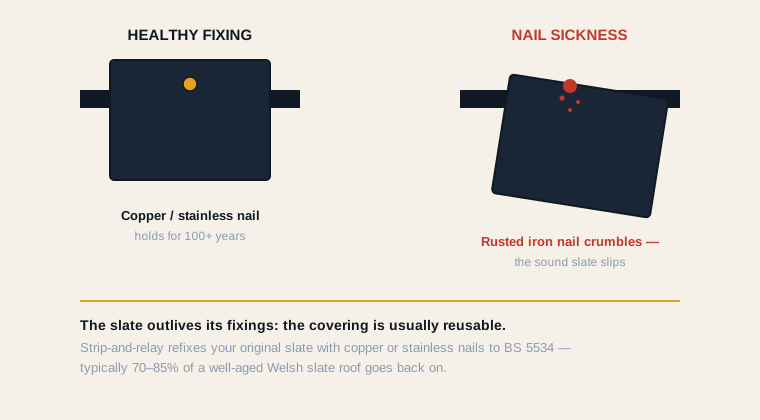
Nail sickness diagram: corroded fixings let sound slates slip while the slate itself remains good
Roof Replacement — technical reference
The process

From First Call to Sign-Off

1. Survey and timber inspection

We assess the covering, battens, underlay and structural timbers, and check for issues specific to your roof's age and Derby stock type.

2. Detailed written quotation

A full fixed-price specification — materials, membrane, battens, lead, scaffold, waste and building control where the 25% threshold applies.

3. Scheduling and scaffold

We book the job, arrange the scaffold, and give you a clear start date and duration.

4. Strip and re-roof

The old covering comes off, defective timber is replaced, new breathable membrane and treated battens go on, and the roof is re-covered with new or reclaimed materials, with all lead renewed.

5. Completion and sign-off

Scaffold struck, site cleared, building control certificate where applicable, and the 10-year workmanship guarantee handed over.

Timescales

Job Durations at a Glance

JobTypical duration
Terraced house re-roof4–6 days
3-bed semi re-roof5–8 days
Detached house re-roof1.5–2.5 weeks
Strip and relay (reusing tiles)4–7 days
Add scaffold erect/strike1 day each end

Extended wet or freezing spells can pause a re-roof — the roof is always left weathertight overnight and in bad weather.

Access

Getting Safely onto Derby Roofs

A full re-roof always needs scaffold for safe working and access — it is included and itemised in the quote, never a hidden extra. Scaffold is specified for: the entire job — a re-roof is never done off ladders - always itemised in your written quote, never a hidden extra, and we arrange it.

Derby's mix of Victorian terraces, post-war estates and city-centre stock means access varies street by street, from tight terraced frontages to open estate roads. Pavement scaffold and skip permits go through Derby City Council; allow a few working days on streets like Sadler Gate, the Wardwick, Friar Gate where space is tight.

Pricing

Roof Replacement Prices in Derby

JobTypical rangeNotes
Terraced house re-roof£5,000–£8,500Concrete tile
3-bed semi re-roof£5,800–£10,000Concrete tile, all-in
Welsh slate re-roof (3-bed)£9,500–£16,000Natural slate
Strip and relay (reuse tiles)25–40% lessWhere tiles are sound
Detached house re-roof£10,000–£20,000+Size and material dependent

What moves the price

Worked example: A concrete-tile re-roof on a 1960s semi in Mackworth — around £7,200 including scaffold, new membrane, battens, renewed lead and waste.

Staged payments on re-roofs — a materials payment when they arrive on site, the balance on completion. Nothing up front before materials. VAT included; empty-property jobs may qualify for reduced 5% VAT.

Covering DE1, DE21, DE22, DE23, DE24 and surrounding postcodes.

Guarantee

Your Guarantee, Explained

The full re-roof carries a 10-year workmanship guarantee in writing, transferable if you sell; tiles, slates and membranes carry manufacturer warranties (often 20–50 years) on top.

If a fault appears in covered work, we come back and put it right. No quibbling, no re-charge.

Good to know

Disruption, Mess & Weather

A re-roof means scaffold up for the duration, some noise during strip and battening, and a skip on site — we protect your garden and drive, sheet the loft, and clear all waste on completion. You do not need to stay home for external work - we just need power and access agreed in advance.

Re-roofing runs through most of the year; we never strip more than we can make weathertight in a day, and temporary covering goes on if weather turns. Derby's inland Midlands position brings genuine winter frosts and Derwent-valley humidity that slows drying.

Frequently Asked Questions

A full re-roof on a Derby 3-bed semi costs £5,800–£10,000 in concrete tile and £9,500–£16,000 in Welsh slate in 2026, including scaffold, membrane, battens, ridge, flashings and waste removal.

Roughly £75–£145/m² for concrete tile, £160–£250/m² for clay, and £180–£300/m² for natural Welsh slate, supplied and fitted. Slate costs roughly double concrete tile.

Derby is a Midlands market with labour rates around 10–15% below London and the South East. The same 3-bed re-roof that costs £11,500 in London is nearer £8,500–£10,000 in Derby.

Often yes — if the tiles are sound, a strip-and-relay reusing them over new membrane and battens saves 25–40% against full new tiles. This is common on Derby's concrete-tile estates like Mackworth and Sinfin.

Yes — properties in Friar Gate, the Cathedral Quarter, Little Chester or Darley Abbey typically cost 20–40% more due to required matched materials, lime mortar and correct-code lead. We explain the premium in the quote.

Everything: scaffold, breathable membrane, treated battens to BS 5534, ridge and verge work, lead flashings, and waste removal by skip. The price is fixed after a proper survey — no mid-job extras.

A concrete-tile re-roof on a 3-bed semi takes 3–5 working days once scaffold is up. Welsh slate adds 2–3 days. We confirm the full timeline in the written quote before starting.

Get Started

Free Quotes Across Derby

Free written quotes across Derby and Derbyshire. No obligation, no hidden costs, 10-year guarantee on all work.

0133 240 5131

Mon–Fri 8am–6pm · Sat 8am–2pm · 24/7 Emergency

More: How to Choose a Roofer · Storm Damage Repairs · Landlord Roofing · Commercial Roofing