Welsh Slate: The Only Correct Material
Victorian terraces in Derby were originally roofed in Welsh blue-grey slate from the Penrhyn and Ffestiniog quarries. This is the correct replacement material for any re-roofing work on visible elevations. Modern concrete interlocking tile on a Victorian terrace is visually inappropriate, structurally mismatched to the original roof pitch and batten spacing, and in conservation area locations constitutes a material change that may require consent and is unlikely to be approved.
Two sources of Welsh slate are available for Derby work: new Welsh slate from currently operating quarries (Penrhyn and Aberllefenni produce slate closest in character to Victorian-era material), and reclaimed Welsh slate from demolitions and roof replacements. For conservation area properties where close matching to adjacent properties is required, reclaimed material from the same approximate era is preferable. We source reclaimed Welsh slate for Derby conservation area properties regularly and confirm material availability before booking any job.
Lime Mortar: Non-Negotiable on Pre-1919 Properties
Standard Portland cement mortar is the wrong specification for Victorian terrace chimneys and ridge mortar in Derby. Cement mortar is harder and less permeable than the original brick and stonework, trapping moisture that would otherwise evaporate through the mortar joint. On Victorian Derby properties this causes accelerated masonry decay — the mortar holds moisture against the brick face, frost cycling drives it into micro-cracks, and spalling accelerates. The correct specification is hydraulic lime mortar (NHL 2 or NHL 3.5 depending on the substrate). We carry lime mortar on every van working on period Derby properties and apply it automatically without needing to be asked.
Lead Flashings: Code Specification Matters
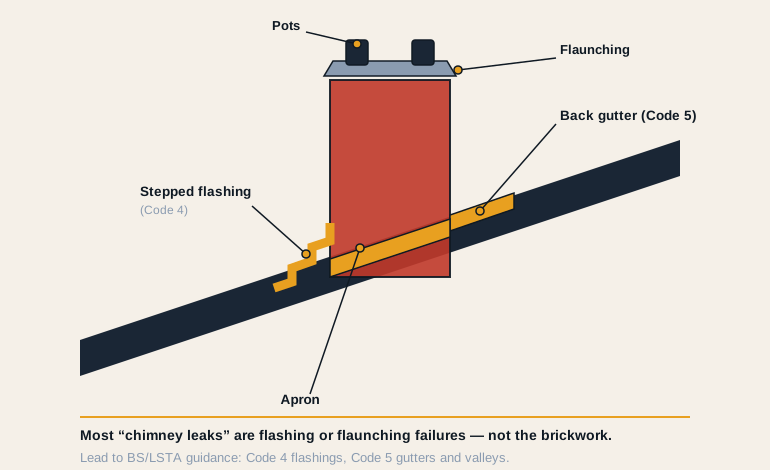
Victorian Derby terraces typically have: lead step flashings at chimney stacks (Code 4 minimum), lead valley linings where hipped sections meet (Code 5), lead bay window flat roofs where present (Code 6 on the oldest properties), and lead parapet cappings on properties with parapet walls. The standard of lead work on Victorian properties needs to be correct not just for weathertightness but for longevity — Code 4 lead has a 60–80 year design life, Code 3 lead has 25–40 years. Getting the code right on a Victorian property means the lead work outlives the current homeowner.
Conservation Area Requirements in Derby
Several of Derby's Victorian terrace areas carry conservation area designation: Friar Gate (full conservation area with Article 4 Direction removing some permitted development rights), Cathedral Quarter, and parts of Darley Abbey. For these properties, any roofing work affecting the external appearance requires like-for-like material specification and in some cases prior consent. We advise on consent requirements as part of every survey on Derby conservation area properties. We won't start work where consent may be required without first confirming the planning position in writing.
Nail Sickness: The Long-Term Challenge
Victorian Welsh slate roofs in Derby are typically in their 100–130th year of life. The slates themselves are almost always sound — Welsh slate quarried in the Victorian era is extremely durable and the surface condition of individual slates is usually good. What fails is the iron or mild steel nail used to fix each slate to the batten. These nails corrode progressively, and as they corrode the nail head enlarges slightly, pulling through the nail hole in the slate and causing the slate to slip. This is nail sickness. Individual slate slippage can be managed with lead clips or re-nailing. When the nail sickness is widespread across the full roof surface, a full re-slate using stainless steel fixings is the appropriate long-term solution. Call Derby Roofing Experts on 0133 240 5131 for a free assessment of your Derby Victorian terrace.
Need a Roofer in Derby?
Free quotes, no call-out fees, 10-year guarantee on all work.
☎ Call 0133 240 5131Questions & Answers
Welsh slate is the correct specification for visible elevations on all Derby Victorian terraces. Concrete tile is inappropriate and may not be accepted in conservation areas.
Yes — standard Portland cement mortar traps moisture and accelerates masonry decay on Victorian brick and stonework. NHL lime mortar is the correct specification and what we use automatically on all pre-1919 Derby properties.
Like-for-like Welsh slate replacement is generally permitted development. Material change (e.g. to concrete tile) requires consent and is unlikely to be approved in conservation areas. Article 4 Directions in Friar Gate remove some permitted development rights.
The progressive corrosion of the iron nails used to fix Victorian Welsh slates, causing slates to slip as the nail head pulls through the nail hole. The slates themselves are usually sound; the fixings are what fail. Common on Derby Victorian properties aged 100+ years.
Full Welsh slate re-roof on a standard Derby Victorian terrace: £7,000–£14,000 depending on size, complexity and whether reclaimed or new slate is used. Conservation area properties at the upper end of the range.
Yes — we source reclaimed Welsh slate for repair and re-roofing work on Derby period properties. We confirm availability and suitability before booking any job where material matching is required.
80–100 years minimum, with many Victorian Derby roofs still serviceable at 130+ years. The slate itself typically outlasts the fixings — nail sickness affects the nails before the slate surface deteriorates.