Concrete Interlocking Tile: 40–60 Years
The dominant roofing material on Derby's post-war estate housing — Normanton, Chaddesden, Mackworth, Alvaston, Sinfin and similar — has a design life of 40–60 years. The tile itself typically reaches the upper end of this range. What fails first on concrete tile roofs is not the tile but the mortar at ridges and verges, which has a design life of 60–80 years in sheltered conditions but deteriorates faster in Derby's exposed western positions. A concrete tile property built in 1960 will typically need ridge mortar maintenance from around year 20, with the tiles themselves remaining serviceable until year 50–60.
What shortens concrete tile lifespan in Derby: pressure washing (strips the weathering surface, opens micro-cracks), poorly specified mortar repairs (rigid cement mortar cracks faster than flexible polymer), and prolonged moss growth on north-facing slopes. What extends it: timely ridge and verge maintenance, correct moss treatment on the 5-year cycle, and keeping valleys and gutters clear.
Welsh Slate: 80–100+ Years
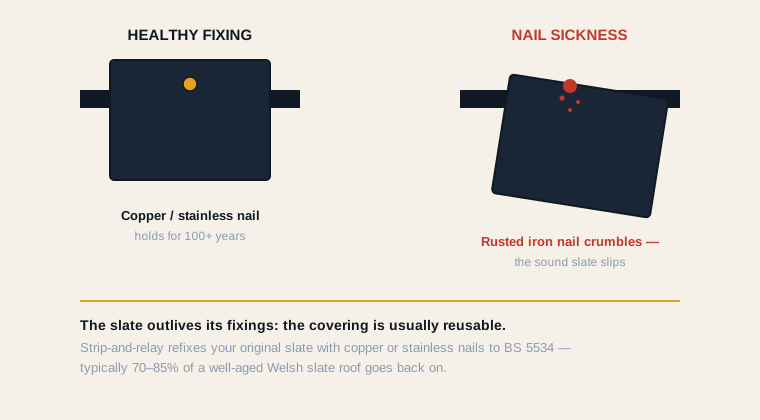
Welsh slate is the original material on Derby's Victorian and Edwardian housing stock — Friar Gate, the Cathedral Quarter, Little Chester, parts of Normanton Road, the older Belper terraces. Correctly installed Welsh slate has a documented lifespan of 80–100 years minimum. Victorian-era Welsh slate on Derby properties is often still serviceable after 130 years. The failure mode is not the slate itself but the fixings: the nails used to fix slates to battens corrode over time (nail sickness), and individual slates slip as the nail head pulls through the nail hole. The slates themselves are typically sound; the fixing is what fails.
Nail sickness on Derby's Victorian properties typically becomes apparent from year 80–100, when individual slates begin to slip progressively. At this stage, a decision is required: repair individual slates as they slip (economical in the short term, increasingly labour-intensive), or full re-slate to eliminate the failing fixings (more expensive upfront, but resolves the underlying cause).
GRP Fibreglass Flat Roofs: 25–40 Years
GRP fibreglass is the correct flat roof specification for Derby garages and extensions. The manufacturer warranty is 25 years, and real-world service life on correctly installed GRP in Derby's climate extends to 35–40 years. The primary failure risk is not the membrane itself but the deck beneath it: GRP applied to a deck that continues to deteriorate will delaminate as the deck moves. A correctly installed GRP flat roof on a sound deck should not require attention within the first 25 years.
Traditional Felt Flat Roofs: 10–15 Years
Traditional felt flat roofs on Derby garages have a realistic lifespan of 10–15 years in Derby's freeze-thaw climate. The lap joints and seams fail as thermal cycling progressively opens them. Modern modified bitumen felt systems perform better (12–18 years) but still carry the fundamental joint failure mechanism that GRP eliminates. Call Derby Roofing Experts on 0133 240 5131 for advice on your specific property.
Extending Roof Life on Derby Properties
The single most cost-effective action for extending the serviceable life of a Derby roof is timely ridge and verge mortar maintenance. Deferring mortar maintenance on a concrete tile roof beyond the natural maintenance window allows tile displacement during storms, which creates immediate repair costs and potential water damage that significantly exceeds the cost of the deferred maintenance. A ridge repoint at the right time — when mortar is approaching end of bond life but before displacement occurs — costs £400–£600 and extends the roof's service life by another 20–25 years. The same repair carried out as an emergency after a storm costs the same but with additional consequential damage costs.
The second most effective action is keeping valleys and gutters clear. On Derby properties with tree cover, a blocked valley heading into winter can cause more damage in a single season than a decade of gradual tile weathering. A £80–£150 November gutter and valley clear prevents damage that can cost thousands to remediate. Call Derby Roofing Experts on 0133 240 5131 to arrange a roof health check on your Derby property.
Need a Roofer in Derby?
Free quotes, no call-out fees, 10-year guarantee on all work.
☎ Call 0133 240 5131Questions & Answers
40–60 years for the tiles themselves. Ridge and verge mortar typically needs attention from year 20 onward. Properties built in the 1960s across Normanton, Chaddesden and Mackworth are now in their second mortar maintenance cycle.
80–100 years minimum. Victorian-era Welsh slate on Friar Gate and Cathedral Quarter properties is often still serviceable after 130 years. Failure is typically nail sickness rather than slate deterioration.
When: repair costs are approaching 50% of replacement cost, the same area has been repaired more than twice, deck boards on a flat roof are softened, or nail sickness on a Welsh slate roof has progressed to the point where individual slates are slipping progressively across the full roof surface.
Pressure washing concrete tiles, poorly specified mortar repairs, blocked valleys and gutters causing ponding water, and deferred maintenance on ridge and verge mortar that leads to tile displacement.
25-year manufacturer warranty, with real-world service life extending to 35–40 years on a correctly installed GRP flat roof on a sound deck.
Building records, planning applications and estate agent history often indicate approximate age. Visual clues: concrete interlocking tile suggests post-1960s construction; clay plain tile suggests pre-1940s; Welsh slate suggests Victorian or Edwardian. A professional survey will assess remaining condition.
Yes — Derby's Pennine-edge weather creates more freeze-thaw cycling than sheltered southern locations, which accelerates mortar failure and felt deterioration. Exposed western-facing properties in Mickleover and Littleover see faster mortar deterioration than sheltered eastern suburbs.