The standard advice for gutter cleaning is “once a year, in autumn.” For much of Derby, that’s reasonable. For a meaningful proportion of Derby properties, it’s not enough — and for properties in the most sheltered, open-aspect parts of the city, once every two years is perfectly adequate. The difference is tree cover and proximity to the Derwent valley woodland corridor.
Why Location Matters More Than the Calendar
Gutters block for one primary reason: debris accumulates faster than rainfall clears it. In Derby, the debris volume is almost entirely driven by leaf fall from nearby trees and moss/lichen fragments washing off roof surfaces. Both of these vary enormously depending on where in the city you are.
A property in Chellaston with a well-maintained garden and no large trees within 20 metres is generating almost no leaf debris. Its gutters may go 18–24 months between needing attention. A property in Allestree backing directly onto the woodland belt above Allestree Park is receiving leaf fall from mature trees throughout October and November, augmented by moss washing off a north-facing roof in every heavy rain event. Its gutters may need clearing twice a year: once after the main autumn leaf fall, and once in spring to clear the moss and smaller debris that accumulate through winter.
Derby’s High-Frequency Zones
The following Derby areas consistently generate the most frequent gutter clearing calls, and where we recommend twice-yearly clearing as a baseline:
- Allestree — particularly properties backing onto Allestree Park or the woodland between Allestree and Quarndon
- Darley Abbey — riverside trees and the mature woodland above the village
- Duffield and Milford — Derwent valley both sides, significant tree cover
- Borrowash — riverside and flood plain vegetation
- Mickleover — mature garden trees are common on larger 1930s–50s properties
The Low-Frequency Zones
Properties in the following areas typically manage well with annual clearing and can sometimes extend to 18-month intervals if roof surfaces are moss-free:
- Chellaston — predominantly newer development, open aspect
- Oakwood — newer estate, limited mature tree cover
- South Normanton and the more open Chaddesden roads — urban density limits nearby tree cover
What Happens When You Don’t Clear Them
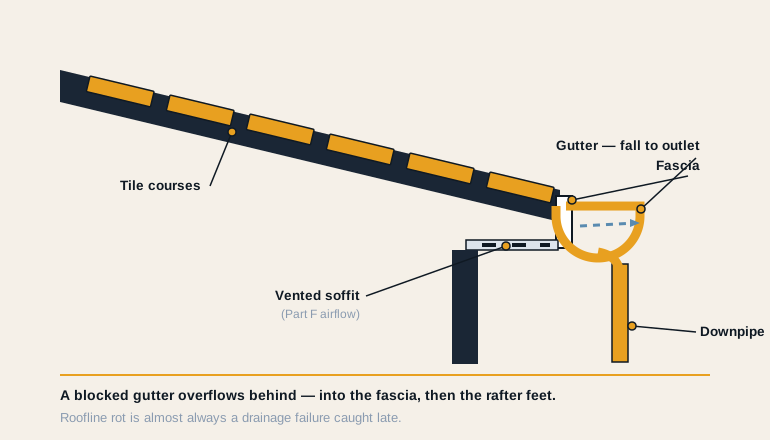
A blocked gutter doesn’t fail quietly. The first sign is usually overflow during heavy rain — water pouring over the front of the gutter rather than draining away. In Derby’s wet winters, this overflow saturates the wall below repeatedly. Over one or two winters, this leads to damp penetration, mortar erosion at the wall face, and eventually moisture getting into the internal structure. The repair bill for damp remediation and pointing repair on a wall that’s been receiving regular gutter overflow for two years is significantly more than two years of gutter clearing.
There’s also a fascia board dimension. Persistent gutter overflow means the fascia board behind the gutter stays wet. Timber fascias rot from the back face — the face you can’t see — and the first visible sign is often a gutter pulling away from a softened fixing point. At that stage, fascia replacement rather than just clearing is the outcome.
The Right Clearing Method
Clearing gutters from a ladder is standard for single-storey access. For two-storey and above, a roofer with appropriate access equipment and insurance is the correct approach — not a neighbour with an extending ladder. A proper clear includes removing all debris, flushing from the top of the run downward, checking that downpipe outlets are free, and confirming all brackets are holding the gutter at the correct fall for drainage. A “cleared” gutter where the outlet is still partially blocked will overflow in the first significant rainfall regardless of how clean the rest of the run is.
Need a Roofer in Derby?
Free quotes, no call-out fees, 10-year guarantee on all work.
☎ Call 0133 240 5131