★ 4.9/5 · 127 Google Reviews · Sinfin Lead Roofing
Lead Roofing in Sinfin
Lead roofing and flashing specialists covering Sinfin and the DE24 area. Chimney step flashings, valley linings, bay window roofs and parapet capping — all in correctly specified Code 4 or Code 5 lead with a 10-year workmanship guarantee.
Tell us the job in 30 seconds. No pushy sales, no call-out fee.
20+
Years Local
127
5★ Reviews
24/7
Emergency
10yr
Guarantee
✓ NFRC Registered
✓ Fully Insured
✓ 10 Year Guarantee
✓ Free Quotes
✓ No Hidden Costs
Lead Roofing in Sinfin
Lead Roofing — Sinfin
On Sinfin's older properties, failed lead is often under-specified. Sinfin's open, low-lying estate roads leave gable verges exposed to wind-driven rain. Sinfin's post-war estate housing gives good open access; its concrete-tile roofs share the estate-wide mortar failure pattern. We replace it properly, sized for the thermal movement the local weather drives.
Lead Specification for Sinfin Properties
Every Sinfin job starts with a free survey and a written, fixed-price quote — no call-out fee. Sinfin's post-war estate housing gives good open access; its concrete-tile roofs share the estate-wide mortar failure pattern. We tell you honestly what the roof needs and what it does not, whether you are near Sinfin Lane or Arleston Lane.
Mastic Over Lead — What We Find in Sinfin
A recurring finding on Sinfin properties built before 1980 is mastic applied over deteriorating lead flashings. The pattern is consistent: a previous roofer patches with mastic, the mastic lasts 3–5 years, the homeowner calls us with a recurrent leak, and we find the original lead failure still present beneath multiple mastic layers. We strip the mastic completely, assess the underlying lead, and either re-dress if salvageable or replace to the correct specification. We never apply mastic over existing mastic.
Bay Window and Valley Lead Work in Sinfin
Bay window flat roofs are a common feature on Sinfin's Victorian and Edwardian terraces. The original Code 6 lead on the oldest bay roofs has often survived 80+ years and may still be serviceable. Where it has cracked from thermal fatigue it needs replacement rather than patching. Valley linings and parapet capping similarly require correct code lead at the right drip detail to prevent water running behind the coping.
Why Sinfin Specifically Matters for Lead Roofing
Sinfin's post-war council housing sits on low-lying ground south of Derby, with a significant proportion of flat-roofed garages and extensions now well past the original felt design life. For lead roofing work in Sinfin, the correct specification must account for these local conditions rather than applying a generic Derby-wide approach. We have carried out lead roofing work across Sinfin and understand the specific requirements of the area.
Free Quotes in Sinfin
All quotes in Sinfin are free, provided in writing, and fixed before any work starts. Call 0133 240 5131 to arrange a free inspection. We typically respond to Sinfin enquiries the same working day.
Typical Pricing in Sinfin
Chimney step flashings: £400–£900 | Valley lining replacement: £500–£1,200 | Bay window lead roof: £600–£1,500 | Parapet capping: £800–£2,000 | All work Code 4/5 lead
Much of the failed leadwork we replace in Sinfin was under-specified or over-long when first installed, so it split as it expanded and contracted. Correct-code lead, properly sized with expansion joints, is what stops the same failure recurring at the same junctions year after year.
“Ridge repoint on our 1960s semi. They inspected the verge at the same time — found more work needed.”
X. Durrant · Sinfin Lane, Derby
★★★★★
“Emergency winter call-out. Made safe same day, permanent repair the following week.”
Y. Marsden · Sinfin, DE24
Do you need it?
Do You Actually Need Lead Roofing?
For Sinfin homeowners, spotting the problem early is half the battle. Lead is the traditional weatherproofing for the vulnerable junctions of Derby's older roofs — flashings, valleys, bay and porch roofs, parapet gutters. When it fails, water gets into the most awkward parts of the roof. We see this pattern regularly on Sinfin properties across the DE24 area — sinfin's open.
The common warning signs include:
A leaking lead bay or porch roof on a Victorian property
A damp patch where the roof meets a wall, chimney or parapet
Lead flashing lifted, cracked, or pulled out of the mortar joint
Splits in an over-long run of lead from thermal movement
When it is not the answer: If a flashing has simply lifted from the mortar and the lead is sound, re-dressing and re-pointing it is enough — full renewal would be oversell Read the full guide.
Lead Roofing — technical referenceThe process
From First Call to Sign-Off
1. Inspection and diagnosis
We assess the lead's code, condition and detailing — much failure is from wrong-code or over-long lead installed cheaply. In Sinfin, scheduling also accounts for Derby City Council permit timescales where scaffold is needed.
2. Fixed written quote
A fixed price to renew in correct-code lead with traditional detailing.
3. Booking you in
Safe access is arranged for the leadwork.
4. Carrying out the work
Failed lead is stripped and renewed in correct-code lead — Code 4/5 for flashings and valleys — with welted joints and correct sizing for thermal movement.
5. Tidy-up and handover
We confirm the detail is weathertight and hand over the guarantee.
Timing
Job Durations at a Glance
Job
Typical duration
Renew a flashing
half a day
Lead valley renewal
1–2 days
Bay/porch roof re-lead
1–2 days
Parapet gutter re-line
2–3 days
Heritage leadwork (complex)
2–4 days
Lead is dressed on site and needs workable conditions — heavy rain pauses the work. Access on tighter Sinfin streets like Sinfin Lane can add a little to these times, which we flag upfront.
Access
Getting Safely onto Sinfin Roofs
Leadwork needs safe standing time, so scaffold or a secure tower is arranged for most jobs beyond a simple flashing. Scaffold is specified for: valleys, bay roofs, parapet gutters and any leadwork needing sustained standing time - always itemised in your written quote, never a hidden extra, and we arrange it.
Sinfin's post-war estate housing gives good open access; its concrete-tile roofs share the estate-wide mortar failure pattern. Pavement scaffold and skip permits go through Derby City Council; allow a few working days on streets like Sinfin Lane, Arleston Lane where space is tight.
Whether it is a simple flashing or complex bay/parapet work
Heritage detailing and matched materials
How much associated covering must be lifted and relaid
Worked example: Renewing a lead valley on a Victorian slate terrace in Peartree — around £950 including access.
Staged payment on larger leadwork, balance on completion. No large deposit. VAT included.
Covering DE24 and surrounding postcodes.
The guarantee
Your Guarantee, Explained
Leadwork carries a 10-year workmanship guarantee; correctly-installed lead to BS EN 12588 lasts 60–100 years, far outlasting the cheap alternatives it often replaces. It is the same written guarantee across all of Sinfin and the DE24 area.
Covered: workmanship for 10 years, in writing, transferable if you sell.
On top: manufacturer warranties on materials (terms vary by product).
Not covered: storm or impact damage - that is an insurance matter, and we will document it for your claim.
Should anything covered go wrong, we return and fix it — no argument, no extra bill.
Good to know
Disruption, Mess & Weather
Contained work at the roof junctions, some access scaffold, and minimal disruption inside — most leadwork is invisible from the ground once done. You do not need to stay home for external work - we just need power and access agreed in advance.
Lead can be worked in most conditions but is dressed and detailed best in the dry; correctly-sized lead with expansion joints handles Derby's temperature swings without splitting. Sinfin's open, low-lying estate roads leave gable verges exposed to wind-driven rain.
FAQ
Questions About Lead Roofing in Sinfin
Chimney step flashings: £400–£900. Valley lining: £500–£1,200. Bay window roof: £600–£1,500. Free quotes on all Sinfin lead work.
Correctly specified Code 4 lead has a design life of 60–80 years. Original Victorian lead on Sinfin period properties is often still serviceable after 100+ years.
Yes — if the lead is structurally sound (not cracked through, not thinned below 1mm) it can be re-dressed to restore the correct profile. Where it has fatigued and cracked, replacement is necessary.
Lead is the required specification for all conservation area and listed building work in Sinfin. Lead-alternative products are not accepted.
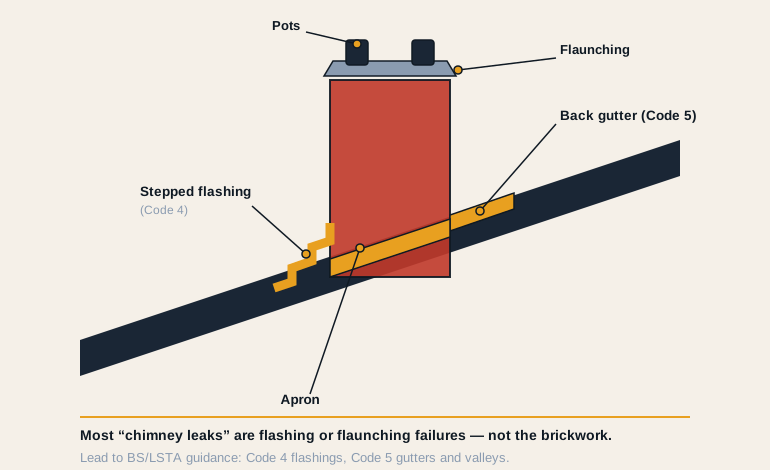
Code 4 (1.80mm) for chimney step flashings and soakers. Code 5 (2.24mm) for apron flashings, valley linings and bay window roofs where greater thermal stress applies.
Yes — we strip all existing mastic, assess the underlying lead, and either re-dress or replace to correct specification. We never apply more mastic over existing mastic.
Lead flashings most often fail at concealed junctions — where step flashings meet soakers, or where aprons meet walls. The visible surface can look intact while the critical junction has opened. We inspect from working height.