Modern Properties (Post-1980)
Modern properties — the volume-built detacheds and semis that make up most of Oakwood, Chellaston, Stenson Fields and the newer parts of Mickleover — typically use concrete interlocking tile on a breathable underlay with aluminium or stainless steel nail fixings. The roofing system is designed to be low-maintenance for approximately 20–30 years, after which ridge and verge mortar checking becomes a maintenance requirement, and at 30–40 years the mortar will begin to fail in the same pattern as Derby's older estate stock.
Common maintenance items from year 20 onward: ridge and verge mortar inspection and repoint, gutter clearing and bracket checking, moss treatment on north-facing slopes, Velux or rooflight flashing inspection. Full replacement is typically not required until year 40–60 if the original installation was to a good standard.
Post-War Estate Properties (1950s–1980s)
This is Derby's largest residential roofing category — the council and private estate housing that makes up Normanton, Chaddesden, Mackworth, Spondon, Alvaston, and dozens of smaller estate pockets across the city. These properties are now 40–70 years old. The majority were built using concrete interlocking tile on bituminous felt underlay with steel wire nail fixings. The felt and nail fixings on the oldest of these properties are now past their design lifespan.
The most significant current maintenance requirement across this category is ridge and verge mortar — the 1960s–70s estate stock is now experiencing widespread simultaneous failure as described in detail elsewhere in this blog. Full replacement consideration is appropriate for the oldest properties in this category (pre-1965 construction) and for any property where the underlay condition is unknown and the roof has never been replaced.
Victorian and Edwardian Properties (Pre-1919)
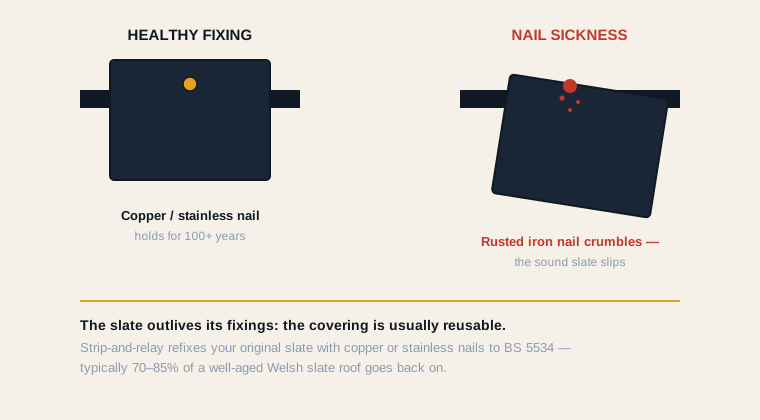
Derby's Victorian and Edwardian stock — Friar Gate, the Cathedral Quarter, parts of Normanton Road, Darley Abbey, and the older streets of Belper, Ilkeston and the surrounding towns — uses Welsh slate on a timber lath substrate with no underlay. The original Victorian slating practice was to bed slates on timber laths with no secondary barrier — the slates themselves were the weatherproofing, and quality Victorian slating will still perform in this way after 130 years.
Key differences from modern roofing: lime mortar on ridge and verge (not cement), original Welsh slate that cannot be directly matched by modern material, and large chimney stacks with lead flashings that are now 80–130 years old. The maintenance requirement is specialist and requires different materials and skills from standard estate roofing.
The Conservation Area Dimension
A significant proportion of Derby's Victorian stock falls within conservation areas — Darley Abbey and Friar Gate being the primary residential designations. For these properties, material choice is constrained by planning requirements as well as by the practical need to match the existing roof on an architecturally significant building. Period-appropriate materials are not just a preference; they're a planning requirement.
Need a Roofer in Derby?
Free quotes, no call-out fees, 10-year guarantee on all work.
☎ Call 0133 240 5131Questions & Answers
Yes — Victorian and Edwardian properties require different materials (Welsh slate, lime mortar, Code 4/5 lead) and different skills from post-war estate roofing. A contractor experienced only in modern concrete tile work may not carry the right materials or have the experience for period property repair.
Welsh slate correctly installed has a design life of 80–100 years. Concrete interlocking tile is 40–60 years. The premium for slate over concrete tile on a re-roof is significant, but the lifespan difference means the two materials are more comparable per year of service than the initial cost suggests.
Ongoing maintenance costs for period properties are broadly similar to post-war stock — the work is different (slate matching, lime mortar) but the frequency is comparable. The main premium occurs when full re-roofing is needed and matched reclaimed slate must be sourced.
They can attempt it, but the material knowledge and sourcing experience matters. A contractor who doesn't stock lime mortar or carry reclaimed slate will either use incorrect materials or cause delays waiting for sourcing. Ask specifically about their experience with the era and type of your property before committing.