How to tell roof-sourced damp and mould from condensation in a Derby rental, why it matters for compliance, and how to fix the cause — a practical guide for landlords.
Tell us the job in 30 seconds. No pushy sales, no call-out fee.
📞 Call Now: 0133 240 5131Roof-sourced damp in a Derby rental shows as staining that worsens after rain, tracks from a chimney, valley or flashing, and coincides with a visible roof defect. It is distinct from condensation, which is uniform and ventilation-related. Roof-caused damp is the landlord's responsibility to fix, and increasingly a defined compliance hazard.
The single most useful thing a Derby landlord can do about damp is work out whether it is coming from the roof or from condensation, because the responsibility, the fix and the compliance picture differ. Getting this wrong — treating a roof leak as a ventilation problem, or blaming the tenant's lifestyle for what is actually a failed flashing — wastes money and can leave a genuine defect unaddressed.
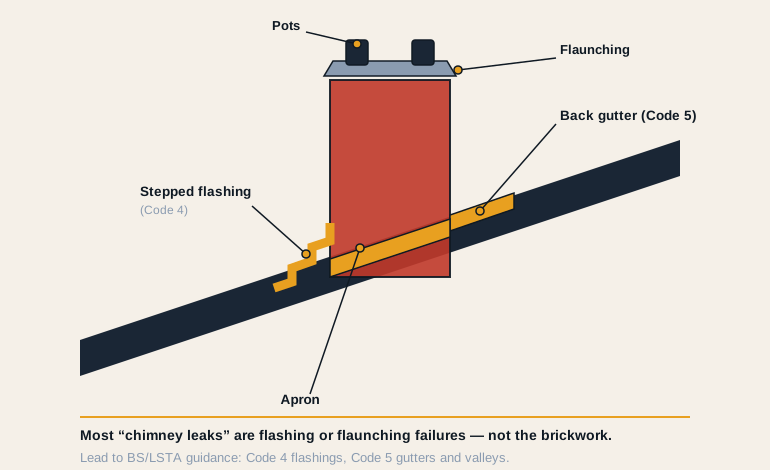
Roof-sourced damp has tell-tale signs: it appears or worsens after rain, especially driving rain; it is localised, often as a defined patch on a ceiling, in a top-floor room, on a chimney breast, or where the roof meets a wall; and it frequently coincides with a visible roof defect — slipped slates, a lifted flashing, a blocked valley, a failed chimney. It follows the weather.Condensation, by contrast, is usually more uniform, worst in cold weather rather than after rain, concentrated in bathrooms, kitchens and behind furniture on cold external walls, and linked to humidity, heating and ventilation rather than the roof. It is a real problem — and one that can still engage the fitness duty — but it is not a roof repair, and re-roofing will not fix it. The two also behave differently over time: roof damp appears in bursts tied to rainfall and tends to worsen as a defect grows, while condensation waxes and wanes with the seasons and the way the home is heated and ventilated. Watching how the damp behaves across a few weeks is often as revealing as looking at the roof itself.Certain roof defects cause the majority of roof-sourced damp in Derby's rental stock, and they vary by the age of the property. On the Victorian and Edwardian terraces of Normanton, Peartree and the inner suburbs, the usual culprits are failed chimney flashings and pointing (damp on the chimney breast), slipped or nail-sick slates, and failed lead valleys between roof slopes. The tall, exposed stacks on these terraces are especially prone to letting water in as their mortar weathers.
On the post-war estates — Mackworth, Sinfin, Chaddesden — the common causes are failed ridge and verge mortar allowing water under the tiles, and blocked or failed guttering letting water run down the wall and track inside. On any property, blocked gutters are a leading and easily-fixed cause of damp that presents as if it were penetrating damp. Identifying which of these is at work is what a proper roof inspection establishes.
The reason this matters for compliance is that each of these is a repair the landlord is responsible for, and each, left unaddressed, can produce the damp and mould that engages the fitness duty and the direction of Awaab's Law. Fixing the roof cause is fixing the compliance problem at source.
Damp and mould have moved to the centre of rental compliance. The Homes (Fitness for Human Habitation) Act 2018 already makes freedom from damp part of the fitness standard, and Awaab's Law — in force for social housing and enabled for later extension to the private sector under the Renters' Rights Act 2025 — puts strict timescales around investigating and fixing damp and mould hazards in the sectors it covers.
For a Derby landlord, the practical upshot is that roof-caused damp is not a cosmetic issue to defer; it is a hazard to diagnose and fix promptly. Where the roof is the cause, a landlord who acts fast, fixes the actual defect, and documents it is on solid ground. A landlord who ignores repeated reports, or papers over mould without addressing the roof cause, is exposed — both to the tenant's direct remedies under the fitness Act and to the tightening regulatory standard.
The mistake to avoid is treating the symptom. Painting over mould, or fitting a dehumidifier, does nothing if a failed flashing is letting water into the wall behind it. The durable fix for roof-caused damp is to repair the roof defect — renew the flashing, refix the slates, rebuild the valley, clear or repair the gutters, repoint or reflash the stack — so the water stops getting in. Once the source is fixed, the affected area can dry and be made good.
Our approach for Derby landlords is to diagnose honestly first: inspect the roof and, where possible, the loft, establish whether the damp is genuinely roof-sourced, and if it is, fix the cause and document it. If it turns out to be condensation, we say so and point you to the real solution — ventilation and heating measures — rather than sell you roof work that will not help. Either way you end up addressing the actual problem, which is what compliance and the tenant both require.
Real properties are rarely tidy, and one of the most common situations is damp with more than one cause — a genuine roof defect and a ventilation problem in the same home. A slipped tile might be letting a little water into a bedroom while, separately, an under-ventilated bathroom is growing mould on the ceiling. Blaming everything on one cause, in either direction, leaves half the problem unfixed and the tenant still complaining.
This is where an honest, roof-first diagnosis earns its keep. We identify and fix what is genuinely the roof — the defect that is our job and your Section 11 responsibility — and we tell you clearly where the remaining issue is ventilation, so you can address that too, whether through extractor fans, trickle vents, or improved heating. A landlord who fixes the roof cause and points the tenant toward managing condensation has covered both bases; a landlord who fixes only one has not.
The compliance point is that the fitness standard does not care which cause you find easier to blame. If the home has damp and mould making it unfit, the duty is engaged regardless of the mix of causes. Addressing all of them — roof and ventilation — is what actually resolves the hazard and closes the compliance exposure, and it is the outcome a straight-talking roofer helps you reach.
For a Derby landlord, the most useful habit is to take every damp report seriously and get it properly diagnosed rather than guessing. A ten-minute phone description cannot reliably separate a failed flashing from a ventilation problem; a proper inspection can. Getting the diagnosis right first time means you spend money on the fix that actually works, resolve the tenant’s complaint, and build the documented record that protects you — rather than paying twice because the first ‘fix’ addressed the wrong cause.
The Homes (Fitness for Human Habitation) Act 2018 makes freedom from damp part of the fitness standard, and a roof defect causing damp or mould can render a rental unfit, giving tenants a direct remedy.
— Homes (Fitness for Human Habitation) Act 2018
Roof-sourced damp worsens after rain, is localised, and coincides with a visible roof defect. Condensation is uniform, worst in cold weather, concentrated in bathrooms and behind furniture, and linked to ventilation rather than the roof.
Yes — where damp is caused by a roof defect, repairing it falls under the landlord's Section 11 duty, and unaddressed damp can also breach the fitness standard under the Homes (Fitness for Human Habitation) Act 2018.
Failed chimney flashings and pointing, slipped or nail-sick slates, failed lead valleys, failed ridge and verge mortar, and blocked or failed guttering — varying by whether the property is a Victorian terrace or a post-war estate home.
Not yet — it applies to social housing from October 2025. The Renters' Rights Act 2025 enables extension to private rentals, but no commencement date is confirmed. The fitness duty on damp, however, already applies to private landlords.
Yes — blocked or failed gutters let water run down the wall and track inside, often presenting like penetrating damp. It is a common and easily-fixed cause that a roof inspection identifies.
No — if the cause is a roof defect, painting over mould or using a dehumidifier treats the symptom while water keeps getting in. The durable fix is to repair the roof defect so the source of water stops.
We tell you honestly and point you to the real solution — ventilation and heating measures — rather than sell roof work that won't help. Condensation can still engage the fitness duty, so it still needs addressing.
Fast, compliant, documented. No call-out fee.
📞 0133 240 5131Free quotes, no call-out fee, 10-year guarantee on all work.
☎ Call 0133 240 5131Call now for free advice or a written quote.