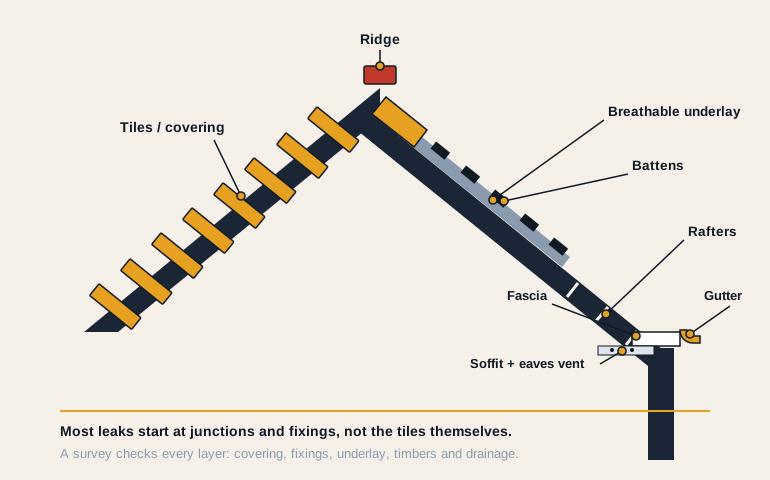
A plain-English guide to Derby landlords' legal roof repair obligations — Section 11, the Homes Act 2018, Awaab's Law and the Renters' Rights Act 2025, and what they mean in practice.
Tell us the job in 30 seconds. No pushy sales, no call-out fee.
📞 Call Now: 0133 240 5131Derby landlords are legally responsible for keeping the roof in repair under Section 11 of the Landlord & Tenant Act 1985, and for keeping the home fit under the Homes (Fitness for Human Habitation) Act 2018. Awaab's Law adds damp-and-mould timescales for social housing, with private-sector extension enabled but not yet commenced under the Renters' Rights Act 2025.
The bedrock of a Derby landlord's roofing responsibility is Section 11 of the Landlord and Tenant Act 1985. It implies a repairing obligation into almost every residential tenancy of less than seven years, and it cannot be contracted out of. The landlord must keep in repair the structure and exterior of the dwelling — and the roof is explicitly part of the structure and exterior.
In practice this means that if the roof leaks, a flashing fails, tiles slip, or a chimney lets water in, it is the landlord's job to put it right, and to do so within a reasonable time of being told. What counts as reasonable depends on severity: an active leak into a living space is urgent; a minor issue with no immediate consequence allows more time. Crucially, the duty is triggered by notice — the landlord generally has to know, or have been told, about the disrepair before the obligation to fix it bites. That makes a tenant's report the moment the clock starts, and a documented fast response the landlord's best protection.
The obligation is to repair, not necessarily to improve. Section 11 does not require a landlord to upgrade a sound roof, but it does require them to remedy disrepair — and where a roof has failed, a proper repair or, if that is the only effective remedy, replacement of the failed element is what is required.
The Homes (Fitness for Human Habitation) Act 2018 significantly strengthened tenants' position. It requires that a rented home is fit for human habitation at the start of and throughout the tenancy. Where it is not, the tenant can take action directly against the landlord in the courts, without having to persuade the local authority to act first.
Fitness is assessed against a list of matters that includes freedom from damp and adequate protection from the elements — both squarely roof issues. A roof defect that lets water in, or that causes persistent damp and mould, can render a property unfit within the meaning of the Act. For a Derby landlord that means a neglected roof is not just a Section 11 repair issue; it can be a fitness issue that gives the tenant a powerful direct remedy. The two duties overlap and reinforce each other.
As things stand, Awaab's Law applies to the social rented sector, where it came into force on 27 October 2025. It does not yet apply to private landlords. The Renters' Rights Act 2025 contains the legal power to extend Awaab's Law to the private rented sector through later secondary legislation, but the commencement date for that extension is subject to consultation and has not, at the time of writing, been confirmed. Anyone telling you Awaab's Law already binds private landlords is overstating the current position.
That said, the direction of travel could not be clearer, and a leaking roof causing damp and mould is exactly the hazard the framework targets. The prudent Derby landlord treats roof-sourced damp as a priority now — both because the fitness duty already applies, and because the compliance bar is only going one way. Waiting for the regulations to catch up is a poor strategy when the fix is the same either way: keep the roof sound.
Pulling it together, a Derby landlord's roofing obligations come down to a few practical points. You must keep the roof in repair; you must act within a reasonable time of being told about a problem; you must ensure the home stays fit, which a roof defect can undermine; and you should treat damp and mould as a priority hazard in anticipation of tighter rules. None of this requires gold-plating — it requires keeping the roof sound and responding promptly when something goes wrong.
The landlords who find compliance easy are the ones who maintain proactively and respond fast, and who keep dated, itemised records of the work. Those records — what was reported, when, what was done, and when — are what demonstrate you met your duty if it is ever questioned. A roofer who provides that documentation as standard makes compliance a by-product of getting the roof fixed properly.
If you are weighing whether a tired rental roof needs repair or replacement, the decision turns on condition and the pattern of failure rather than a fixed rule, and getting an honest assessment is the sensible first step before either spending on repairs that will not hold or committing to a replacement that is not yet needed.
It is worth understanding what tenants can do if a Derby landlord fails to meet these obligations, because the routes have become more direct and more powerful. Under Section 11, a tenant who has reported disrepair and seen no reasonable action can bring a claim for the landlord to carry out the repairs and for compensation for the disrepair and any resulting damage to their belongings or health. The court can order the work done and award damages.
The Homes (Fitness for Human Habitation) Act 2018 added a second, direct route: a tenant can take the landlord to court over an unfit property without needing the local authority to act first, which historically was a significant hurdle. Separately, the local authority retains its own enforcement powers under the Housing Health and Safety Rating System, and can serve improvement notices requiring roof defects that pose a hazard to be remedied.
For the landlord, the lesson is straightforward and reassuring: none of these routes is a threat to a landlord who keeps the roof in repair and responds promptly to reports. They are a problem only for the landlord who ignores disrepair. The whole framework rewards the same behaviour — fix the roof, respond fast, keep records — which is exactly what a good roofer helps a landlord do as a matter of routine.
In short, the legal framework around Derby landlords and roofs is not something to fear. It asks for exactly what a responsible landlord would do anyway: keep the roof sound, respond promptly when a tenant reports a problem, fix the actual defect rather than paper over it, and keep a record. Do that, and Section 11, the fitness Act and the coming reforms all take care of themselves. The landlords who get into difficulty are, almost without exception, the ones who let roof problems drift — and roof problems, left to drift, only ever get more expensive and more serious.
Section 11 of the Landlord and Tenant Act 1985 requires landlords to keep the structure and exterior — including the roof — in repair, a duty that cannot be excluded from the tenancy.
— Landlord & Tenant Act 1985, section 11
Yes — Section 11 of the Landlord and Tenant Act 1985 implies a duty to keep the structure and exterior, including the roof, in repair. It cannot be contracted out of and applies throughout the tenancy.
Not yet. Awaab's Law applies to social housing from 27 October 2025. The Renters' Rights Act 2025 enables extension to the private rented sector, but the commencement date is subject to consultation and has not been confirmed.
Generally once the landlord knows or has been told about the disrepair. That is why a documented, prompt response to a tenant's report is important — the clock starts on notice.
Yes — under the Homes (Fitness for Human Habitation) Act 2018, a roof defect causing damp, water ingress or mould can make a property unfit, giving the tenant a direct legal remedy against the landlord.
Within a reasonable time of being notified, judged by severity — an active leak is urgent, a minor issue allows more time. Social-housing damp and mould has fixed statutory timescales under Awaab's Law.
Section 11 requires remedying disrepair. Usually that means a repair, but where a roof element has genuinely failed and repair will not remedy it, replacing that element is what the duty requires.
Dated, itemised records of what was reported, when, what was done and when it was completed. This evidences that repair and fitness duties were met if ever questioned.
Fast, compliant, documented. No call-out fee.
📞 0133 240 5131Free quotes, no call-out fee, 10-year guarantee on all work.
☎ Call 0133 240 5131Call now for free advice or a written quote.