The void period between tenancies is the ideal time for roof maintenance. A practical Derby landlord checklist — what to inspect, what to fix, and why it pays off.
Tell us the job in 30 seconds. No pushy sales, no call-out fee.
📞 Call Now: 0133 240 5131The void period between tenancies is the best time for roof maintenance on a Derby rental: the property is empty, access is unrestricted, and small problems can be fixed before a new tenant moves in. A between-tenancy roof check should cover gutters, tiles and slates, flashings, the chimney, and any signs of damp in the loft.
Every landlord knows the void period between tenancies is when non-urgent property work gets done — and the roof should be on that list. With the property empty, you have unrestricted access, no need to coordinate around a tenant's schedule or give notice, and the freedom to carry out inspection and maintenance that would be disruptive with someone living there. It is the natural window for the roof check that keeps small problems from becoming tenant complaints.
The economics strongly favour it. A minor repair caught between tenancies — a slipped tile refixed, a gutter cleared, a flashing re-dressed — costs a fraction of the same problem after it has caused a leak, damaged decoration, and generated a habitability complaint from a new tenant in month two. Proactive between-tenancy maintenance is one of the highest-return small investments a Derby landlord can make, and it protects your compliance position by keeping the roof demonstrably sound at handover. There is also a void-cost angle: a roof problem discovered after a new tenant moves in often means repair works around their occupancy, access arrangements, and sometimes alternative accommodation if a room is affected — all of which the empty-property window avoids entirely.
It also protects the relationship with the incoming tenant. A property handed over with a sound, recently-checked roof starts the tenancy without the friction of an early repair issue, and gives you a documented baseline of condition at the start of the term.
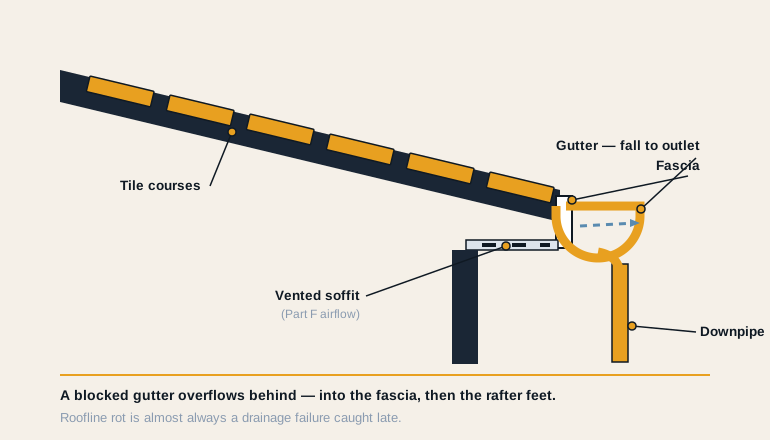
A thorough between-tenancy roof check for a Derby rental covers the same points whatever the property, adjusted for its stock type. Gutters and downpipes first: clear them of debris and check they flow — blocked gutters are the leading cause of avoidable damp, and Derby's tree-lined streets fill them fast. Tiles and slates: look for slipped, cracked or missing units, and on Victorian terraces in Normanton and Peartree, for the scatter of slipped slates that signals nail sickness.
Ridge and verge: on post-war estate homes in Mackworth, Sinfin and Chaddesden, check the ridge and verge mortar for cracking and gaps — the estate-wide failure that lets water and wind under the tiles. Flashings and chimney: check the lead flashings where the roof meets walls and the stack, and the chimney's pointing and flaunching — a leading source of damp on the chimney breast. The loft: go inside and look for daylight, water staining, damp timber or wet underlay — the loft reveals problems long before they show in the rooms below.Finally, the roofline: check the fascias and soffits for rot, especially on older properties, and make sure the eaves are sound and ventilated. A quick run through this checklist, ideally by a roofer who can safely access and properly assess the roof, tells you exactly what — if anything — needs doing before the next tenant arrives.
Not everything the check turns up needs doing immediately, and an honest assessment separates the two. Fix now: anything letting water in or about to — slipped tiles, failed flashings, blocked gutters, a leaking valley, cracked ridge mortar. These are cheap between tenancies and expensive once a tenant is in and the water has caused damage. They are also exactly the defects that engage repair and fitness duties, so clearing them protects your compliance position.
Note for later: things that are wearing but not yet failing — a roofline that will need renewing in a few years, a covering approaching but not at the end of its life, a chimney that will want repointing before long. Recording these with an indicative timescale lets you budget and plan, and turn what would otherwise be a surprise into a scheduled cost. This is the difference between managing a roof and reacting to it.
The final step is to document what you found and did. Dated photographs and an itemised note of the roof's condition and any work carried out create a baseline at the start of the tenancy — useful if a question ever arises about when a defect developed, and evidence that you maintained the property properly. For a portfolio landlord, building this record across a between-tenancy schedule turns roof maintenance into a documented, budgetable routine rather than a series of emergencies.
Handled this way, the roof becomes one of the most predictable and lowest-drama parts of a Derby rental. A short check and a few small fixes in each void period keeps the roof sound, keeps tenants free of leaks, keeps you comfortably on the right side of your obligations, and spreads roofing spend into planned maintenance rather than crisis repair. It is, in every sense, the cheapest time to look after the roof.
There is a seasonal dimension worth planning around. If a void falls in late summer or early autumn, it is the ideal moment for a full roof check and gutter clear before the wet, windy season arrives — Derby's autumn leaf fall and winter storms are what expose the weaknesses a summer roof hides. Clearing gutters and fixing minor defects ahead of winter prevents the blocked-gutter damp and wind-lifted-tile problems that otherwise surface in December with a tenant already in place.
A void in the depths of winter is a different proposition: some work — mortar repointing, certain flat-roof and adhesive work — is weather-sensitive and best deferred to milder conditions, though inspection, gutter clearing and most repairs can still be done. A good roofer will tell you what can sensibly be done now and what is better held for a dry, frost-free window, rather than rushing weather-critical work in poor conditions and having it fail.
The practical takeaway for a Derby landlord is to treat each void as a chance to get the roof ahead of the weather, not just to react to whatever the last tenant reported. A roof checked and cleared before autumn is a roof that sails through winter — and a tenant who never has to report a leak is a tenant who renews.
Building this into how you run a Derby rental portfolio turns the roof from a source of unpredictable emergencies into a managed, budgetable asset. Pair each void-period check with an annual gutter clear on occupied properties, keep the dated records, and act on the ‘note for later’ items before they become ‘fix now’ items, and roofing stops being the thing that generates panicked winter phone calls. It becomes, instead, one of the quiet, well-run parts of the operation — which is exactly where a landlord wants it to be.
Proactive maintenance and prompt repair are the practical core of meeting a landlord's Section 11 repairing duty; a documented void-period roof check evidences that the property was kept in repair.
— Landlord & Tenant Act 1985, section 11
The property is empty, so access is unrestricted, no tenant notice is needed, and disruptive inspection and repair can be done freely. Small problems get fixed before a new tenant moves in and before they cause damage.
Gutters and downpipes, tiles and slates, ridge and verge mortar, flashings and the chimney, the loft interior for damp, and the fascias and soffits — adjusted for the property's age and stock type.
A minor repair between tenancies costs a fraction of the same problem after it has leaked, damaged decoration and triggered a tenant complaint. Proactive maintenance is one of the highest-return small investments a landlord can make.
Anything letting water in or about to — slipped tiles, failed flashings, blocked gutters, leaking valleys, cracked ridge mortar. These are cheap to fix empty and expensive once a tenant is in.
Yes — the loft reveals daylight, water staining, damp timber and wet underlay long before problems show in the rooms below, making it one of the most valuable parts of the check.
Dated photos and an itemised condition note create a baseline at the start of the tenancy, useful if a question arises about when a defect developed, and evidence that the property was properly maintained.
Yes — building a between-tenancy roof check into a schedule turns roof maintenance into a documented, budgetable routine across a portfolio rather than a series of emergency repairs.
Fast, compliant, documented. No call-out fee.
📞 0133 240 5131Free quotes, no call-out fee, 10-year guarantee on all work.
☎ Call 0133 240 5131Call now for free advice or a written quote.