Belper Housing Stock and Roofing Requirements
The character of Belper's housing stock is shaped by its industrial history. The terraced streets around Bridge Street, Strutt Street and the river Derwent are largely 1880s–1910s construction — brick-built mill worker terraces originally roofed in Welsh blue-grey slate from the Penrhyn quarries. The Derwent Valley Mills UNESCO World Heritage Site designation covers the core mill village area, where all roofing work on visible elevations must use period-appropriate materials.
Interwar (1920s–1940s) semi-detached properties are widespread across the higher ground north and east of the town centre, mostly in concrete plain tile. Post-war and modern estates use concrete interlocking tile throughout. Each section of Belper has different roofing requirements.
The Derwent Valley Humidity Effect
Belper's position in the Derwent valley creates higher ambient humidity than the surrounding high ground. The valley floor and properties close to the river experience persistent moisture conditions that accelerate two specific roofing problems:
Moss growth on north and east-facing Belper roof slopes is significantly faster than equivalent Derby city properties. Properties adjacent to the river corridor or with mature tree canopy see moss establishment within 3–4 years of treatment rather than the 5–7 years typical of open-aspect Derby properties. We recommend a 4-year treatment cycle for valley-floor Belper properties and 5 years for higher-ground properties.
Lead flashing corrosion is accelerated by persistent high humidity. Lead flashings on Victorian Belper properties adjacent to the river are subject to greater oxidation stress than equivalent properties on the Derbyshire plateau. Code 4 lead is the correct minimum specification; we apply patination oil to all new lead flashings on Belper valley-floor properties to extend service life.
Welsh Slate Sourcing for Belper Properties
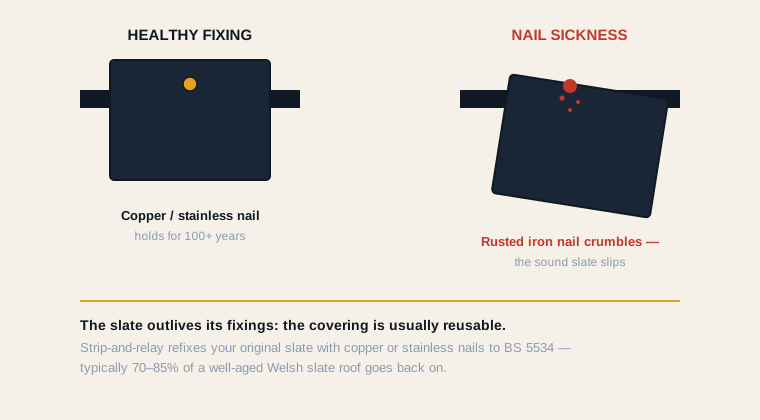
Repair and re-roofing work on Belper's Victorian and Edwardian terraces requires Welsh slate matched to the original specification. The blue-grey Penrhyn-type slate used on most Belper properties from the 1880s–1910s is distinguishable from the darker blue-black Ffestiniog slate used on some properties. We source reclaimed material matched to the specific property before confirming any booking — arriving at a Belper property with the wrong slate colour or texture is not acceptable on period properties where visual consistency matters.
Conservation Area and UNESCO Designation
The Derwent Valley Mills UNESCO World Heritage Site covers the core mill village area of Belper around the Strutt mills and river corridor. For properties within or immediately adjacent to the designated area, all roofing work affecting the external appearance requires like-for-like material specification and in many cases prior consent. We have experience working on Derwent Valley UNESCO-designated properties and advise on consent requirements as part of every survey. Call Derby Roofing Experts on 0133 240 5131 for a free assessment of your Belper property.
Mortar Maintenance on Belper's Post-War Properties
While Belper's Victorian mill terraces attract most of the attention in any roofing discussion of the town, the post-war and interwar semi-detached properties on the higher ground around the town centre are entering their own maintenance window. Properties built in the 1950s and 1960s in areas like Belper's northern suburbs are now 60–70 years old — at the point where ridge and verge mortar is approaching or past end of bond life. The Derwent valley humidity that affects the lower-lying Belper properties also affects these higher-ground properties to some degree, and the mortar deterioration rate in humid conditions is faster than in dry exposed upland positions.
For Belper homeowners with post-war concrete tile properties, the indicators are the same as across the Derby estate housing stock: uneven ridge tiles visible from the pavement, gaps in the pointing between ridge tiles, or a ridge that has been repointed before and is approaching its second cycle. A free inspection from Derby Roofing Experts will confirm whether mortar maintenance is needed and give you a fixed-price quote before any work starts. Call Derby Roofing Experts on 0133 240 5131 to arrange.
Need a Roofer in Derby?
Free quotes, no call-out fees, 10-year guarantee on all work.
☎ Call 0133 240 5131Questions & Answers
Yes — we cover Belper (DE56) as part of our Derby area portfolio. Emergency call-outs typically reach Belper within 2–4 hours.
Welsh slate matched to the original Penrhyn or Ffestiniog quarry type. Concrete tile is not appropriate on visible elevations of Victorian Belper properties, particularly near the conservation area.
Yes — higher humidity accelerates moss growth (4-year treatment cycle recommended for valley-floor properties) and lead flashing corrosion. Properties near the river corridor require more frequent maintenance than high-ground Belper properties.
Yes — all pre-1919 Belper properties require NHL lime mortar for chimney and masonry repointing. Standard Portland cement traps moisture and accelerates masonry decay on Victorian brick.
The Derwent Valley Mills UNESCO World Heritage Site covers the mill village core. Conservation area designation applies to significant parts of central Belper. We advise on consent requirements as part of every survey.
4 years for valley-floor properties near the river. 5 years for higher-ground properties. Belper's Derwent valley humidity creates faster moss growth than open-aspect Derby properties.
Same pricing as Derby: Welsh slate repair £250–£600, ridge repoint £400–£600, moss treatment £150–£600 depending on method. Free written quotes on all Belper roofing work.