NFRC registration — membership of the National Federation of Roofing Contractors — is the most practically useful credential check available to Derby homeowners when choosing a roofer. It's verifiable online, it requires contractors to meet specific standards to join and maintain membership, and its absence is a useful screening signal. This guide explains what it actually means and how to use it.
NFRC-registered roofers in Derby have been vetted by the National Federation of Roofing Contractors for competence, insurance and workmanship standards. Choosing an NFRC member gives access to insurance-backed guarantees and independent recourse. It is one of the clearest quality signals when selecting a Derby roofer.
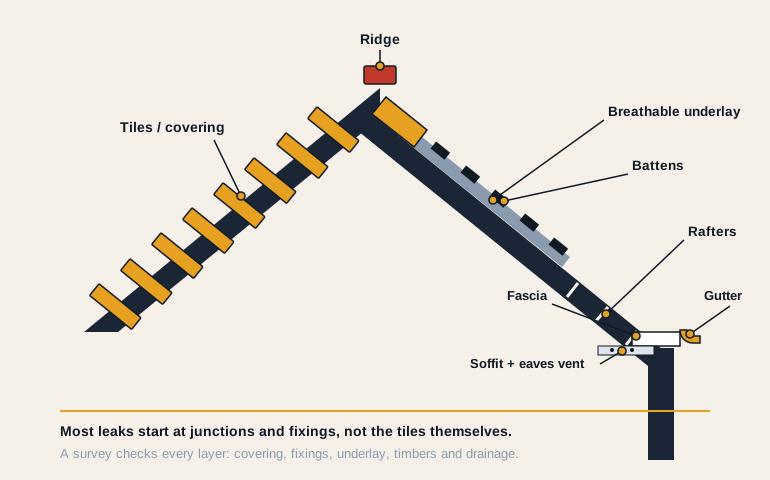
Cross-section of a pitched roof — technical reference
What NFRC Membership Requires
To become and remain an NFRC member, a roofing contractor must maintain adequate public liability insurance, meet workmanship quality standards assessed through the application process, comply with the NFRC's code of conduct, and keep their membership current through annual renewal. New applicants are vetted; their work is assessed and their insurance verified before membership is granted.
NFRC membership does not guarantee perfection — it's a threshold, not a ranking. But it excludes the operators who don't hold adequate insurance, who haven't been through any quality assessment, and who can't commit to a professional code of conduct. In a trade where the consequences of poor work don't become apparent for months or years, this threshold is worth using.
How to Verify NFRC Membership
NFRC maintains a searchable member directory at nfrc.co.uk. You can search by company name or postcode. If a Derby roofer claims NFRC membership, verify it there — don't rely on a badge on a website or a verbal confirmation. Membership should show as current, not lapsed.
Other Credentials Worth Checking
Beyond NFRC, the following are worth verifying for Derby roofing work:
Public liability insurance — ask for the certificate, not just a statement. Check the cover level (£2m minimum, £5m preferred) and expiry date.
Employers' liability insurance — required by law if they employ anyone. A company with employees but no employers' liability insurance is operating illegally.
Companies House registration — search the company name. Legitimate limited companies are registered and their details are publicly available. Sole traders don't register, but a company claiming to be Ltd should be findable.
What Credentials Don't Tell You
Credentials confirm minimum standards and legitimate operation; they don't confirm specific experience with the type of work you need. An NFRC-registered contractor who primarily does commercial industrial roofing may not be the right choice for a Victorian slate re-roof in Darley Abbey. Local reputation, specific experience with the housing type, and local material knowledge matter alongside credentials. Ask about their experience with your specific property type and roofing material — a good contractor will answer precisely.
Need a Roofer in Derby?
Free quotes, no call-out fees, 10-year guarantee on all work.
Yes — we are registered with the National Federation of Roofing Contractors. You can verify our membership on the NFRC website at nfrc.co.uk.
No — NFRC membership is voluntary, and some excellent contractors aren't members. However, absence of NFRC membership removes a useful verification step. When combined with a thorough quote process and local references, it's a useful screening tool rather than the only one.
NFRC membership has no direct cost impact on project pricing. The membership fee is a business overhead. The premium you pay for an NFRC member (if any) reflects their quality standards and insurances, not the membership itself.
First raise the issue directly with the contractor in writing. If unresolved, NFRC members are subject to the Federation's complaints procedure. For non-NFRC contractors, Trading Standards and the small claims court are the primary routes.
Key Takeaways
• NFRC membership is verifiable on nfrc.co.uk — always check directly rather than relying on a badge or verbal confirmation.
• NFRC membership is a threshold check, not a ranking. It excludes operators without adequate insurance and professional standards.
• Public liability insurance (£2m minimum), employers' liability, and Companies House registration are the other key credential checks.
• Credentials confirm minimum standards — specific local experience and material knowledge matter alongside formal credentials.
What NFRC Registration Means in Practice for Derby Homeowners
For a homeowner in Derby selecting a roofer, NFRC registration provides one independently verifiable data point in what is otherwise a difficult assessment. You cannot assess a roofer's workmanship quality before the job starts. You can verify their registration status in under 30 seconds at nfrc.co.uk. That's the practical value: not a guarantee of quality, but a confirmed threshold and an established complaints route if something goes wrong.
The NFRC complaints process is worth understanding. If you have a dispute with an NFRC member contractor that you can't resolve directly, you can refer it to the NFRC for conciliation. The Federation can't award compensation, but it can facilitate resolution and, in serious cases, take action against a member's registration. For non-NFRC contractors, your routes are Trading Standards and the small claims court — a slower and more adversarial process. This is the second practical benefit of NFRC membership beyond the initial credential check.
The Insurance Certificate Check
Asking for the public liability insurance certificate is a step that most Derby homeowners don't take, but it takes less than two minutes and closes a significant risk. An uninsured contractor working on your property means you bear the liability for any injury to the contractor on your premises, and any damage to your property or a neighbour's property caused by the work. The certificate should show the insurer, the policy number, the cover level, and the expiry date. Check that the expiry date is current and that the cover level is adequate — £2m minimum for domestic work, £5m preferred. If a contractor can't or won't produce a certificate, the conversation should end there.
Local Reputation as a Supplement to Formal Credentials
NFRC registration and correct insurance are necessary conditions, not sufficient ones. In Derby's roofing market, local reputation built over years of work on specific housing types adds important context. A contractor who has worked extensively on Derby's 1960s–70s estate concrete tile stock — Normanton, Chaddesden, Mackworth — develops specific material knowledge, established supplier relationships for common profiles, and an understanding of the access and logistics patterns across those estates. This matters when your Normanton ridge repoint needs the right tile profile on the van on day one. We've been building that local knowledge base in Derby since 2003, and it shows in the efficiency and quality of our work across the city's varied housing stock.